
PRESS RELEASE TORONTO, ON, November 2026 —
Early massive black holes, cosmic rotation and dark energy need no exotic primordial ingredients when read through QCD confinement and a counter-rotating vacuum.
https://www.openpr.com/news/4690012/early-massive-black-holes-cosmic-rotation-and-dark-energy-need
Spinning primordial black holes
Zantedeschi (arXiv:2611.15169) proposes that heavy quarks joined by colour flux tubes collapse into fast-spinning black holes. Balaji, Kaiser and colleagues (arXiv:2611.12861) argue that non-Gaussian primordial seeds can explain JWST’s Little Red Dots without violating the CMB μ-distortion bound.
Institute of Integrative and Interdisciplinary Research (IIIR) response finds three problems:
- Real QCD flux tubes break at about one fermi. A hole would need an unbroken tube some ten megaparsecs long, so the mechanism actually requires a string at the grand-unification scale.
- High spin is the default outcome of any collapse of rotating gas, so it does not single out any mechanism.
- The escape from the distortion bound rests on an unmeasured small-scale amplitude and two added free functions.
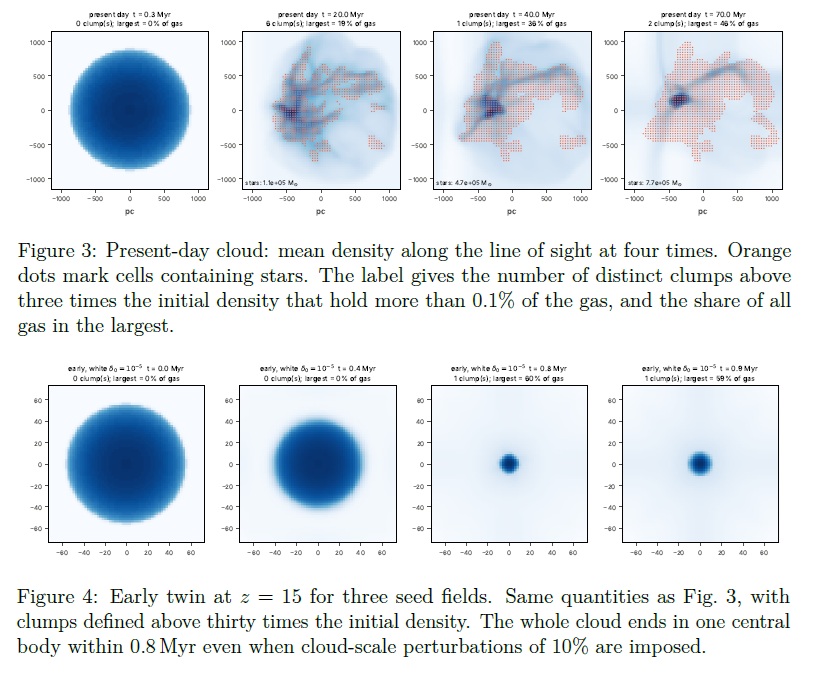
A model with no exotic ingredients then shows that a pristine cloud of 10⁸ solar masses at redshift 15 collapses faster than any star can live. The same mass of gas today fragments and forms stars slowly over tens of millions of years.
“Confinement is our territory. Early black holes need no strings and no primordial spikes, only dense, pristine gas,” said Boris Kriger, Lead Investigator, IIIR.
Filament rotation
Gurzadyan, Fimin and Chechetkin attribute the spin of cosmic filaments to tidal seeding. IIIR response argues that rotation is unavoidable, since any departure from equilibrium produces it. It then sets out, as a fork with distinct observational signatures, what decides which way a filament turns.
Inhomogeneous dark energy
Trivedi and Loeb, and Jain, Trivedi, Khlopov, Levi Said and Krasnov, consider dark energy that varies in space. IIIR response asks whether this requires a new field or is the vacuum’s response to the surrounding matter, and develops the consequences of both branches.
Parity-odd galaxy statistics
Ortolá Leonard and Slepian identify which terms can carry a mirror-asymmetric signal in galaxy clustering. IIIR response proves that an equally counter-rotating vacuum is achiral and leaves that channel empty. It also proves that galaxy spins cannot test a rotating vacuum in either direction.
Falsifiability
The papers name the observations that would decide them:
- natal spin distributions of early black-hole seeds;
- ringdown and post-merger signals of compact objects between 2.2 and 4.0 solar masses, where the programme predicts horizonless objects below the edge and slowly rotating holes just above it;
- a null CMB birefringence monopole;
- spectral distortions beyond μ.
A confirmed black hole below about three solar masses would refute the programme’s density floor.
An invitation
Researchers working on early black holes, cosmic rotation or parity tests are invited to examine the papers and send objections, which will be cited in subsequent work: boriskriger@interdisciplinary-institute.org
Papers
- Why cosmic filaments cannot avoid rotating and what decides which way they turn. https://doi.org/10.13140/RG.2.2.16701.01767
- Captured or free, inhomogeneous dark energy as a new field or as the vacuum’s response to matter. https://doi.org/10.13140/RG.2.2.36833.67686
- Achiral counter-rotation and the parity-odd trispectrum. https://doi.org/10.13140/RG.2.2.12526.37442
- Spin needs no string: Two seeding mechanisms of one week, read against the direct collapse of pristine clouds arrested by deconfinement. https://doi.org/10.13140/RG.2.2.36014.47687
Boris Kriger | Lead Investigator
ORCID: https://orcid.org/0009-0001-0034-2903
https://www.researchgate.net/profile/Boris-Kriger
Institute of Integrative and Interdisciplinary Research
+1 437-552-8807
boriskriger@interdisciplinary-institute.org
About the Institute
The Institute of Integrative and Interdisciplinary Research (IIIR) is a Toronto-based organization dedicated to solving complex problems through formal precision and cross-domain synthesis. Treating interdisciplinarity as a methodological necessity, the Institute bridges the gap between specialized fields to develop coherent theoretical architectures.


Leave a Reply