
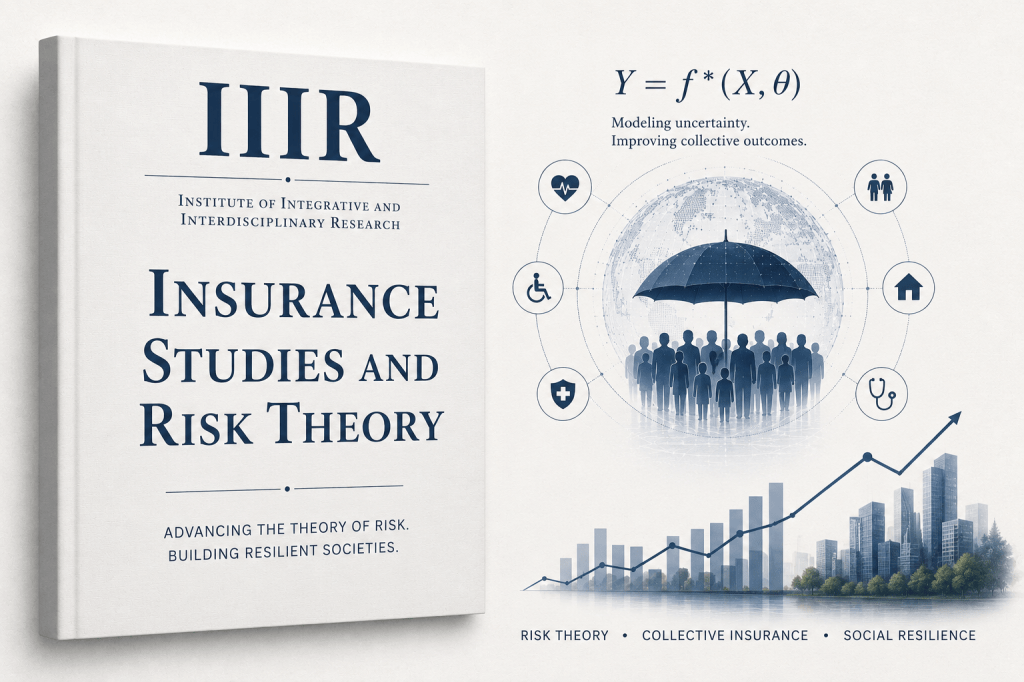
The Department of Insurance Studies and Risk Theory explores one of the most consequential yet least understood aspects of human life: our inability to evaluate catastrophic risk rationally.
Traditional insurance theory often assumes that individuals can assess risks and make informed decisions about their protection. Our department begins from a different premise. Research in psychology, behavioral economics, actuarial science, and decision theory increasingly demonstrates that human beings systematically underestimate some risks, exaggerate others, and struggle to make rational choices when faced with rare but potentially devastating events such as critical illness, disability, long-term care needs, loss of income, or premature death.
The department investigates the consequences of this mismatch between human cognition and real-world risk. We ask a fundamental question: should individuals bear primary responsibility for deciding whether to protect themselves against catastrophic outcomes, or should societies develop collective mechanisms that provide protection by default?
Our research examines the theoretical foundations of insurance, risk perception, uncertainty, actuarial modeling, behavioral decision-making, collective risk-sharing systems, public policy, and social resilience. Particular attention is devoted to the study of low-frequency, high-impact events and to the design of insurance structures that remain effective despite the well-documented limitations of human judgment.
The department advances the concept of collective insurance as a natural response to catastrophic uncertainty. Under this framework, protection against major life risks is viewed not merely as a private consumer choice but as a societal function. Group insurance programs, professional associations, employer-sponsored plans, mutual aid structures, and public insurance systems are studied as mechanisms that can compensate for individual cognitive limitations while improving overall welfare and resilience.
Research areas include:
• Risk theory and uncertainty studies
• Behavioral economics of insurance decisions
• Psychology of catastrophic risk perception
• Actuarial science and quantitative risk modeling
• Collective insurance systems
• Public policy and social protection
• Health, disability, and life insurance frameworks
• Catastrophe and resilience studies
• Ethics of risk distribution and social solidarity
• Future models of universal and default insurance coverage
The department welcomes collaboration from scholars in risk and insurance studies, economics, mathematics, psychology, sociology, public policy, philosophy, law, medicine, and data science. By integrating these perspectives, we seek to develop a more realistic understanding of how human beings confront uncertainty and how societies can build institutions that protect individuals from risks they are often unable to evaluate for themselves.
Our long-term objective is to contribute to a new theory of risk governance in which protection against catastrophic events is guided not only by market mechanisms and individual preferences, but also by empirical knowledge of human decision-making and by principles of collective resilience.

The Hearthkin Project: Collective Protection Through Insurance, Community, and Risk Theory
Kriger, B., Halushko, D., & Matvijenko, L. (2026). Distributed Responsibility and Collective Protection: Theological Coherence, Behavioural Necessity, and the Architecture of Mutual Aid in Religious Communities. IIIR Series in Computational Humanities and Cultural Systems. https://doi.org/10.5281/zenodo.20186572
For proposals of joint projects, academic partnerships, visiting researcher arrangements, or interdisciplinary initiatives, please, contact us at:
research@interdisciplinary-institute.org
 Institute of Integrative and Interdisciplinary Research