
PRESS RELEASE
TORONTO, ON, May 2026 — A Unified Origin of Bulk Flows, Spin Chirality, and Cosmic Dipoles from Rotating RP³ Topology
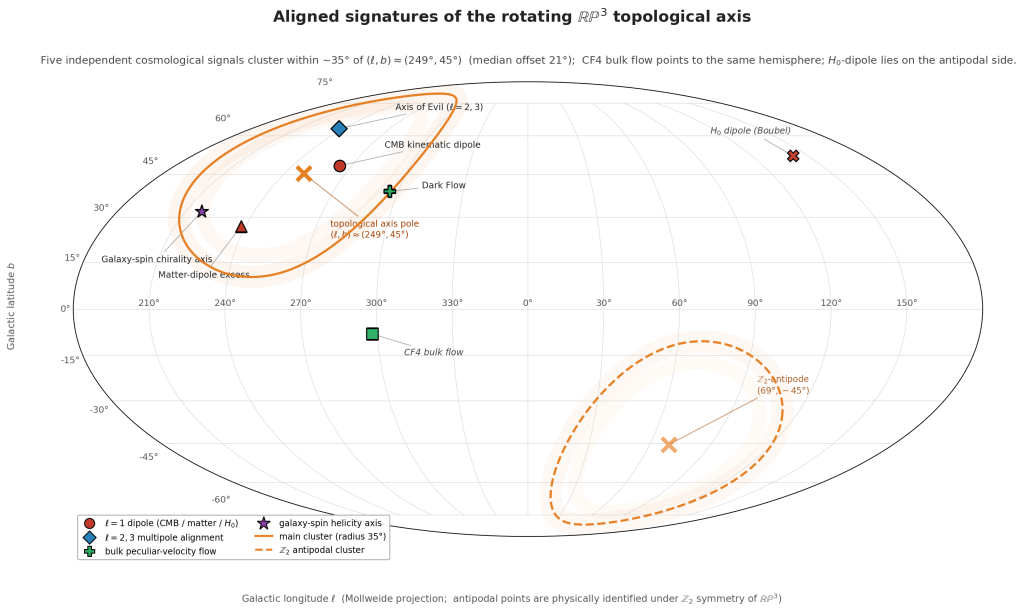
The Local Gravity of the Quantum Vacuum (αLGQV) programme has derived the cosmological constant Λ from first principles by two independent routes — from the QCD chiral condensate and from the rotation of the universe — both converging on the observed value with no free parameters. A new study extends the programme to cosmological perturbations, showing that three of the most discussed anomalies in cosmology — the bulk-flow excess of CosmicFlows-4, the galaxy spin chirality of Longo and Shamir, and the matter-distribution dipole of Secrest et al. — share a single origin in the rotating RP³ topology and align on a common axis within approximately 12 degrees. All three alignments are observed.
Preprint: https://doi.org/10.13140/RG.2.2.33885.58088
Video overview →
The αLGQV programme rests on two derivations of Λ that no other framework provides. The first connects the cosmological constant to the QCD chiral condensate through measured nucleon sigma terms, identifying a coupling constant α ≈ 0.005 from nuclear physics that reproduces the observed expansion rate. The second derives Λ from the centrifugal relaxation of a rotating spacetime on RP³, yielding the same value with zero free parameters. The two routes converge — Λ measured by cosmologists equals Λ derived from quark condensates, equals Λ produced by cosmic rotation. This convergence is the central result of the programme.
The new study applies the same geometry to cosmological perturbations. On the doubly counter-rotating RP³ background, structure formation acquires a helicity asymmetry, peculiar velocities are amplified rather than damped by expansion, and the topological identification axis imprints itself on three independent observational signatures. The framework predicts that the kinematic CMB dipole, the quadrupole–octopole alignment known as the Axis of Evil, and the matter-distribution dipole excess must all align on the same axis on the sky. They do.
“Λ is not a free parameter — it is determined twice over,” said Boris Kriger, Lead Investigator. “Once by nuclear physics, once by topology. The same geometry that fixes Λ also produces the bulk-flow excess, the spin chirality, and the matter dipole. Three communities studying these as separate anomalies are looking at one phenomenon.”
The new study specifies thirteen testable predictions — seven already supported by 2023–2026 observations, six testable in the near term with Roman, Euclid, LSST, DESI, and LiteBIRD, and six observational outcomes that would falsify the framework.
Reception by the Specialist Community
The foundational derivation has been reviewed in documented correspondence by researchers at Stanford/SLAC, Stony Brook (C.N. Yang Institute), University of Cape Town, University of Maryland, University of Minnesota, University of Barcelona, LMU Munich, Kansas State, Karlsruhe Institute of Technology, and Max Planck Institute for Astrophysics, among others. Responses range from substantive endorsement to constructive skepticism. No correspondent identified a derivational error or a hidden free parameter. The summary — including critical responses — is published at:
→ https://interdisciplinary-research.institute/reception/
An invitation.
The Institute invites cosmologists, nuclear physicists, galactic astronomers, and observational scientists to scrutinize, reproduce, and test the results — particularly in their own domains. The framework crosses disciplinary boundaries deliberately, and benefits from review by experts in each connected area. Researchers interested in collaboration on specific predictions, independent numerical implementation, or comparison against new observational data are invited to contact the Institute directly at boriskriger@interdisciplinary-institute.org
Preprint: A Unified Origin of Bulk Flows, Spin Chirality, and Cosmic Dipoles from Rotating RP³ Topology
https://doi.org/10.13140/RG.2.2.33885.58088
Explanatory video: https://youtu.be/EuzFBL06j9g
Full αLGQV programme: interdisciplinary-research.institute/cosmology-and-theoretical-physics
Reception and correspondence: interdisciplinary-research.institute/reception
Boris Kriger | Lead Investigator
ORCID: orcid.org/0009-0001-0034-2903
Institute of Integrative and Interdisciplinary Research, Toronto
+1 437-552-8807 · boriskriger@interdisciplinary-institute.org
About the Institute
The Institute of Integrative and Interdisciplinary Research (IIIR) is a Toronto-based organization dedicated to solving complex problems through formal precision and cross-domain synthesis. Treating interdisciplinarity as a methodological necessity, the Institute bridges specialized fields to develop coherent theoretical architectures.
TORONTO, ON, April 2026 The Cosmological Constant Derived From First Principles by Two Independent Routes Within Known Physics
The cosmological constant Λ drives the accelerating expansion of the universe and accounts for roughly 70% of its energy budget. Despite decades of effort, it has never been derived from first principles — only measured and inserted into equations by hand.
A research programme completed at the Institute of Integrative and Interdisciplinary Research (IIIR, Toronto) now derives Λ analytically from two independent routes, using only established physics. Both converge on the observed value with no free parameters.
Route One: Geometry
Video overview →
The first route rests on a theorem, not an assumption. The three-sphere S³ carries the Hopf fibration: a structure, proven by Heinz Hopf in 1931, that fills all of S³ with nested tori of linked circles. If the spatial topology of the universe is RP³ (the three-sphere with antipodal identification — closed, orientable, and consistent with all CMB data), then the Hopf fibration is physically present. A slow rotation along these fiber circles produces centrifugal relaxation — which is cosmic expansion. The rotation has never been detected in the CMB because the Hopf fiber direction is orthogonal to every three-dimensional observational slice — it is geometrically invisible to the sky. From this structure alone, both the Hubble parameter and Λ emerge as analytic predictions. Notably, the Hopf fibration predicts that matter should trace toroidal patterns at cosmological scales.
The recently discovered Big Ring — a 1.3-billion-light-year annular structure of galaxies at z ≈ 0.8, published by Lopez, Clowes & Williger (JCAP 2024) — has no explanation within standard ΛCDM. In the Hopf topology, it is expected.
Please, follow the link to read the preprint prepared for submition to
JCAP
Route Two: Particle Physics
Video overview →
The QCD sigma terms — experimentally measured quantities describing how the chiral condensate responds to the presence of matter — determine the gravitational contribution of the vacuum. Treated as the elastic response of the QCD ground state, they yield the same Λ. No tuning is involved.
The cosmological constant as a QCD observable: derivation, nonlinear screening, and falsification.
The complete program is available at
The institute has made all 40 papers, derivations, data, and correspondence publicly available and invites physicists, cosmologists, and nuclear scientists worldwide to scrutinize, reproduce, and test the results.
The Connection
The programme traces the problem to a 1967 assumption — that quantum vacuum energy is identical to Einstein’s cosmological constant. Nuclear physicists have measured how vacuum energy changes inside a proton. Cosmologists have measured how Λ governs expansion. These two results, published in separate fields, had never been connected. A single coupling constant, α ≈ 0.005, derived from published nuclear data, now connects them — and reproduces the observed expansion rate, fits all 175 SPARC galaxy rotation curves without dark matter, and accounts for galaxies observed with little or no dark matter, all within one framework.
Reception by the Specialist Community
The derivation has been reviewed in documented correspondence by researchers at Stanford/SLAC, Stony Brook (C.N. Yang Institute), University of Cape Town, University of Maryland, University of Minnesota, University of Barcelona, LMU Munich, Kansas State, Karlsruhe Institute of Technology, and Max Planck Institute for Astrophysics, among others. Responses range from substantive endorsement to constructive skepticism. No correspondent identified a derivational error or a hidden free parameter. The summary — including critical responses — is published at:
→ https://interdisciplinary-research.institute/reception/
Convergence Across the Field
This programme is not isolated. Independent groups have reached compatible conclusions from different starting points — instanton vacuum models (Musakhanov, Phys. Rev. D 111, 2025), SU(3) confinement volume derivations (Ali, arXiv:2507.22096), topological QCD dark energy (Zhitnitsky, UBC), and the elastic vacuum q-theory (Klinkhamer & Volovik). All converge on the same principle: Λ and quantum vacuum energy are physically distinct quantities.
What distinguishes this programme is that it unifies the geometric and particle-physics derivations into a single self-consistent architecture — with explicit falsification criteria. Detection of a dark matter particle, or exclusion of the predicted coupling constant from nuclear data, would refute the framework.
The Core Argument in Six Key Papers
Readers pressed for time should read :
- The cosmological constant as a QCD observable: derivation, nonlinear screening, and falsification.
- Density dependence of QCD vacuum energy from nucleon sigma terms.
- Resolution convergence of nonlinear screening in the gravitatingvacuum model: particle-mesh simulations
- Quantum vacuum replaces dark matter: Isothermal fits to all 175 SPARC galaxy rotation curves. Nature Astronomy, Manuscript NATASTRON-26040505. Submitted.
- CMB Compatibility, Confinement Radiation, and the Gravitational Wave Background from One Action
- Cosmic Expansion as Centrifugal Relaxation: An Analytical Model on RP 3 with Predictions for the Hubble Parameter and Large-Scale Structure
————————————————————-
Boris Kriger | Lead Investigator
ORCID: orcid.org/0009-0001-0034-2903
https://www.researchgate.net/profile/Boris-Kriger
Institute of Integrative and Interdisciplinary Research
Toronto, Ontario, Canada
+1 437-552-8807
interdisciplinary-institute.org boriskriger@interdisciplinary-institute.org
Press Release
TORONTO, ON, April 2026 — Zero-parameter analytical model yields Hubble constant of 71.7 — exactly between the two measurements that have divided cosmology for a decade
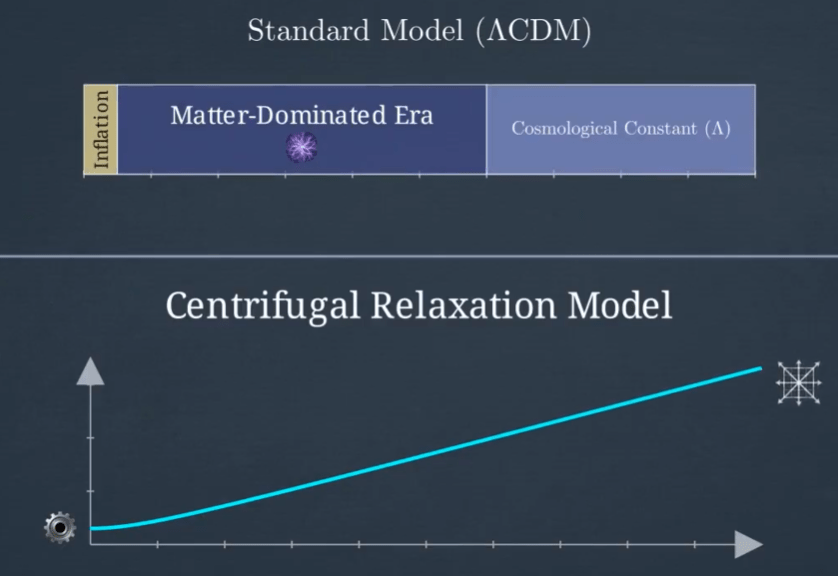
A new paper proves mathematically that cosmic expansion and the passage of time are the same physical process, derives the Hubble constant from nuclear physics with no free parameters, and predicts the exact size of a recently discovered billion-light-year ring of galaxies — to 4% accuracy.
A new study from the Institute of Integrative and Interdisciplinary Research (IIIR) presents an exact analytical solution for the expansion of the universe driven by centrifugal relaxation of a rotating spacetime membrane. The model contains zero free parameters and produces three independent results that match observations.
The preprint is available at: Cosmic Expansion as Centrifugal Relaxation: An Analytical Model on RP³ with Predictions for the Hubble Parameter and Large-Scale Structure. https://doi.org/10.13140/RG.2.2.30657.93283
The paper was motivated by and extends a March 2025 result by Szigeti, Szapudi, Barna & Barnaföldi (Monthly Notices of the Royal Astronomical Society, 538, 3038), who showed that a slowly rotating universe can resolve the Hubble tension — the persistent 5σ disagreement between early-universe (67.4) and late-universe (73.0) measurements of the Hubble constant. Their model uses one free parameter (the rotation rate) and Newtonian approximations. The new IIIR paper eliminates the free parameter entirely and obtains an exact result.
The central mathematical identity.
The paper derives, from the equation of motion of a centrifugally expanding membrane with topology RP³ = S³/Z₂, the identity:
Ṙ = v_time
The expansion velocity of the universe equals the velocity of time. This is not a metaphor — it is a mathematical theorem following from energy conservation. When the membrane rotates at the speed of light (the initial state), expansion is zero and time does not flow. As rotation decelerates through angular momentum conservation, the freed velocity budget transfers into the flow of time. Spatial expansion and the passage of time are the same kinematic process.
The exact trajectory is R(t) = √(R₀² + c²t²) — a hyperbola that transitions from near-stationarity to linear expansion. No inflaton field is needed: the membrane doubles its radius in 3.6 hours and expands a thousand-fold in 0.2 years, driven entirely by centrifugal force. The graceful exit problem does not arise — angular momentum conservation decelerates the expansion automatically.
Three quantitative results from zero free parameters.
All three inputs to the model are determined by prior physics: R₀ = 15 AU from the Kriger density limit (nuclear physics), v_rot = c from the Banach fixed-point theorem (mathematics), and Λ_true = 1.8 × 10⁻⁵² m⁻² from QCD sigma terms (the αLGQV programme). From these:
Result 1: Hubble constant H₀ = 71.7 km/s/Mpc. This falls precisely between the Planck CMB value (67.4 ± 0.5) and the SH0ES distance-ladder value (73.0 ± 1.0). The paper proposes that both measurements are filtered versions of the true expansion rate — Planck through the CMB acoustic model, SH0ES through the distance ladder — and both deviate from the true value in opposite directions. The Hubble tension is not a measurement error but a consequence of measuring material recession velocities rather than the membrane expansion rate itself.
Result 2: Universe size = 21.4 billion light-years. The radius of curvature follows directly from R = √(3/Λ) = 13.6 billion light-years. On RP³ (antipodal points identified), the maximum distance between any two points is πR/2 = 21.4 billion light-years. This is smaller than the ΛCDM value of 46.5 billion light-years — but that value is computed, not measured, and depends on assumptions about dark matter and inflation that this model replaces.
Result 3: Big Ring diameter = 1.35 billion light-years (observed: 1.3). The Hopf fibration — a topological decomposition of the three-sphere into nested tori — predicts ring-shaped structures at specific angular scales. At sin η = f_b/π (where f_b = 0.156 is the Planck baryon fraction), the predicted diameter is 1.35 billion light-years and the circumference is 4.2 billion light-years. The Big Ring, discovered by Lopez, Clowes & Williger in 2024, has diameter 1.3 billion light-years and circumference 4.0 billion light-years — deviations of 4% and 6% respectively. No other model predicts the size of a specific megastructure from first principles.
Key differences from Szigeti et al. (2025).
The Szigeti–Szapudi rotating universe model uses Newtonian equations, one axis of rotation, a nonzero net angular momentum (ω₀ ≈ 0.002 Gyr⁻¹ as a free parameter), and does not predict large-scale structure. The IIIR model uses the topology RP³ = S³/Z₂, two orthogonal planes of isoclinic Clifford rotation (possible only in four dimensions), zero net angular momentum (L_total = 0 by construction, satisfying the Planck CMB isotropy constraint), zero free parameters, and predicts both the Hubble constant and the sizes of observed megastructures.
“Szigeti and Szapudi showed that rotation can solve the Hubble tension — that was an important insight,” said Boris Kriger, Lead Investigator. “We show that rotation does solve it, and the answer is 71.7. No parameter was adjusted. The number comes from pion-nucleon scattering cross-sections measured in nuclear physics laboratories.”
Twelve consequences.
The centrifugal mechanism, without additional assumptions, eliminates the need for the inflaton field, resolves the graceful exit problem, explains the isotropy of the CMB (zero net angular momentum), replaces three expansion epochs with a single analytical curve, derives the cosmological constant from nuclear physics, explains apparent spatial flatness as a consequence of centrifugal inflation, establishes time as freed rotational velocity, explains the cosmic web as a frozen Hopf fibration, prevents singularity through five independent barriers, provides a self-sufficient expansion engine with no external agent, predicts a finite universe between two elastic limits, and resolves the coincidence problem (why dark energy density approximately equals matter density today).
Falsifiable predictions.
The paper specifies predictions that can be tested with existing or near-future data: (1) a mirror-reflected Giant Arc on the opposite side of the sky at redshift z ≈ 0.8; (2) Ω_K = −0.044 (testable with CMB-S4); (3) correlation between the apparent evolution of dark energy and the local density of the cosmic web; (4) matched circles in the CMB from the multiply-connected RP³ topology.
Limitations.
The paper explicitly identifies limitations: the equation of motion omits gravitational self-deceleration, the CMB spectrum has not been fully computed on RP³, and the Hopf angle η = 2.85° is supported by two independent approaches (baryon fraction projection and nonlinear mode cascade) but lacks a rigorous first-principles derivation.
The paper has been submitted for peer review and is available as a preprint.
The preprint is available at: Cosmic Expansion as Centrifugal Relaxation: An Analytical Model on RP³ with Predictions for the Hubble Parameter and Large-Scale Structure. https://doi.org/10.13140/RG.2.2.30657.93283
The full αLGQV research program is available at: https://interdisciplinary-research.institute/cosmology-and-theoretical-physics/
Boris Kriger | Lead Investigator ORCID: orcid.org/0009-0001-0034-2903 https://www.researchgate.net/profile/Boris-Kriger
Institute of Integrative and Interdisciplinary Research +1 437-552-8807 interdisciplinary-institute.org boriskriger@interdisciplinary-institute.org
About the Institute The Institute of Integrative and Interdisciplinary Research (IIIR) is a Toronto-based organization dedicated to solving complex problems through formal precision and cross-domain synthesis. Treating interdisciplinarity as a methodological necessity, the Institute bridges the gap between specialized fields to develop coherent theoretical architectures.
TORONTO, ON, April 2026 — The universe rotates — and that rotation may explain dark matter, galaxy structure, and three long-standing cosmological anomalies
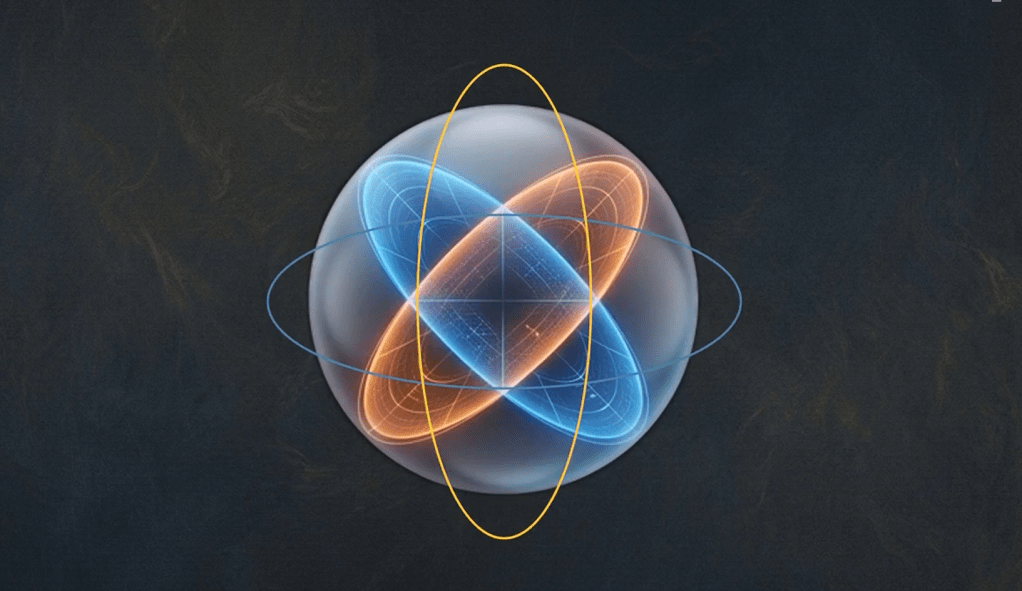
A new study proposes that the dark matter problem is not a missing mass problem but a misidentified reference frame problem: the universe itself rotates, and the resulting frame-dragging — the same effect confirmed by NASA’s Gravity Probe B near Earth — produces the gravitational anomalies conventionally attributed to invisible matter.
The preprint is available at: Galaxy Spin Chirality, Rotation Curves, and CMB Parity from Double Counter-Rotation on RP³: Frame-Dragging as the Origin of the Dark Sector. https://doi.org/10.13140/RG.2.2.27247.60323
The study begins from topology. The spatial topology RP³ = S³/Z₂ is derived — not assumed — from three established results: the Banach fixed-point theorem (uniqueness of physical constants requires a unique attractor on a compact manifold), the Perelman theorem (the only simply connected closed 3-manifold is S³), and CPT symmetry (the antipodal identification S³/Z₂ is the unique geometric implementation of CPT on S³). On this topology, the isometry group SO(4) decomposes into two independently conserved angular momenta, and counter-rotation (L₁ = −L₂, total angular momentum zero) is the unique stationary state.
The paper derives the gravitomagnetic metric of the doubly rotating S³ and shows that the resulting frame-dragging produces three independent effects from a single mechanism:
1. Enhanced effective gravity. The gravitomagnetic force on orbiting matter adds to Newtonian gravity, producing G_eff = G(1 + 2α_eff) with α_eff ≈ 0.365. This flattens galaxy rotation curves without dark matter — the same formula previously derived independently from QCD sigma terms in the αLGQV programme, applied to 175 SPARC galaxies with zero free halo parameters. The convergence of two independent derivations on the same formula is the central result.
2. Galaxy morphology. Frame-dragging stabilises spiral arms against the winding problem (arms should dissolve in ~500 Myr but persist for billions of years), produces bars as projections of the cosmic rotation axis onto the galactic disk, and explains why barless galaxies are preferentially found in dense environments where interactions disrupt the frame-dragging pattern. Galaxies are not scaled-up solar systems — they are vortices in rotating space, analogous to hurricanes on a rotating planet.
3. Gravitational lensing without dark matter. Because frame-dragging modifies the spacetime metric itself, photons following null geodesics experience the same gravitational enhancement as orbiting matter. The lensing mass equals (1 + 2α_eff) × visible mass — the same factor as for rotation curves. In the Bullet Cluster, the gravitomagnetic field passes through the collision unimpeded (it is a property of spacetime, not matter), reproducing the observed offset between lensing mass and X-ray gas without dark matter.
The study additionally shows that the same rotation explains:
— The JWST early galaxy formation crisis: enhanced gravity accelerates collapse by a factor of 1.32 at each stage, and eliminates the need to wait for dark matter halos to form first.
— Galaxy spin asymmetry (Longo 2011; Shamir 2020): the Coriolis effect from cosmic rotation imparts a preferred handedness to galaxy spins, producing the observed dipole.
— CMB parity anomaly (Planck, 99% confidence): the Z₂ antipodal identification on S³ acts differently on odd and even multipoles, producing the observed odd-multipole excess.
— Star formation concentrated in spiral arms: gravitomagnetic and vacuum compression in the arms push gas density above the Jeans threshold; inter-arm regions remain sub-Jeans.
— Fractal hierarchy of cosmic structure: the galaxy distribution has fractal dimension D ≈ 2.1–2.2 on scales 1–100 Mpc, matching the fractal dimension of vortices in rotating fluids — not the D = 3 (homogeneity) predicted by ΛCDM.
A unified Lagrangian is derived from the geometry of RP³ alone: gravity from the scalar curvature of the rotating metric (Einstein–Hilbert action), electromagnetism from the curvature of the Hopf connection intrinsic to S³ (no extra dimensions), and charge quantization from Z₂ holonomy. No fields, particles, or dimensions are added.
The Planck constraint on cosmic vorticity (ω/H₀ < 10⁻⁹) is satisfied exactly: the double counter-rotation has L_total = 0 by construction.
“For a century, we have been the blind physicist on a rotating planet, measuring anomalies and inventing invisible forces to explain them,” said Boris Kriger, Lead Investigator. “Dark deflection. Dark asymmetry. Dark energy. Then someone says: the planet rotates. Every anomaly vanishes. We propose that the universe rotates — and the dark sector is the shadow of that rotation.”
Five falsifiable predictions are specified: (P1) the galaxy spin asymmetry axis converges to Galactic coordinates (l, b) = (273°, +39°); (P2) CMB parity ratio R⁺ > 1; (P3) DESI filaments show measurable chirality; (P4) Ω_K = −0.044 (testable with CMB-S4); (P5) tensor-to-scalar ratio r = 0 (testable with LiteBIRD). None of these predictions can be produced by ΛCDM.
The paper has been submitted for peer review and is available as a preprint.
The preprint is available at: Galaxy Spin Chirality, Rotation Curves, and CMB Parity from Double Counter-Rotation on RP³: Frame-Dragging as the Origin of the Dark Sector. https://doi.org/10.13140/RG.2.2.27247.60323
The full αLGQV research program is available at: https://interdisciplinary-research.institute/cosmology-and-theoretical-physics/
Boris Kriger | Lead Investigator ORCID: orcid.org/0009-0001-0034-2903 https://www.researchgate.net/profile/Boris-Kriger
Institute of Integrative and Interdisciplinary Research +1 437-552-8807 interdisciplinary-institute.org boriskriger@interdisciplinary-institute.org
About the Institute: The Institute of Integrative and Interdisciplinary Research (IIIR) is a Toronto-based organization dedicated to solving complex problems through formal precision and cross-domain synthesis. Treating interdisciplinarity as a methodological necessity, the Institute bridges the gap between specialized fields to develop coherent theoretical architectures.
TORONTO, ON, April 23, 2026 —All known giant cosmic structures may be connected — and a single model explains why
A new analysis maps every known megastructure and cosmological anomaly onto a common framework, revealing a pattern of nested rings, universal scale ratios, and clustered preferred directions that standard cosmology does not predict.
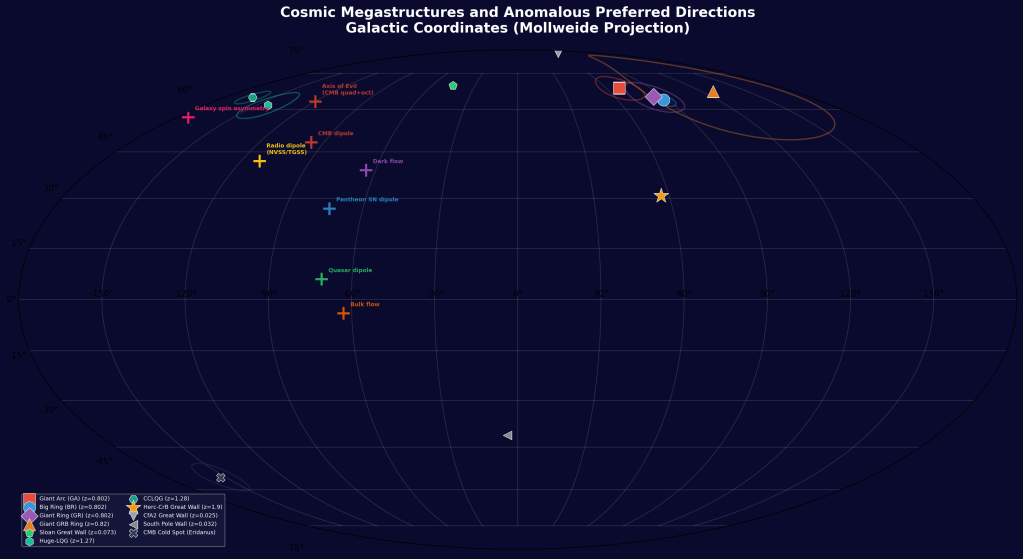
A new study from the Institute of Integrative and Interdisciplinary Research (IIIR) presents the first systematic cross-identification of all known ultra-large-scale structures in the observable universe — including the recently discovered Giant Ring, the Big Ring, the Giant Arc, the Giant GRB Ring, the Sloan Great Wall, and other megastructures — alongside eight independently reported cosmological anomalies such as the CMB “Axis of Evil,” the Dark Flow, and the quasar dipole.
The preprint is available at: Cosmic megastructures as projections of Hopf fibration tori: Scale hierarchy, nesting, and preferred directions in the gravitating vacuum framework. https://doi.org/10.13140/RG.2.2.12331.60965
The analysis reveals that these apparently unrelated phenomena form a coherent spatial pattern: three nested rings at the same cosmic distance, a universal size ratio of approximately 2.2 between paired structures across three independent redshift shells, and a clustering of all anomalous preferred directions within a 33-degree patch of sky — oriented at 75 degrees from the megastructure cluster.
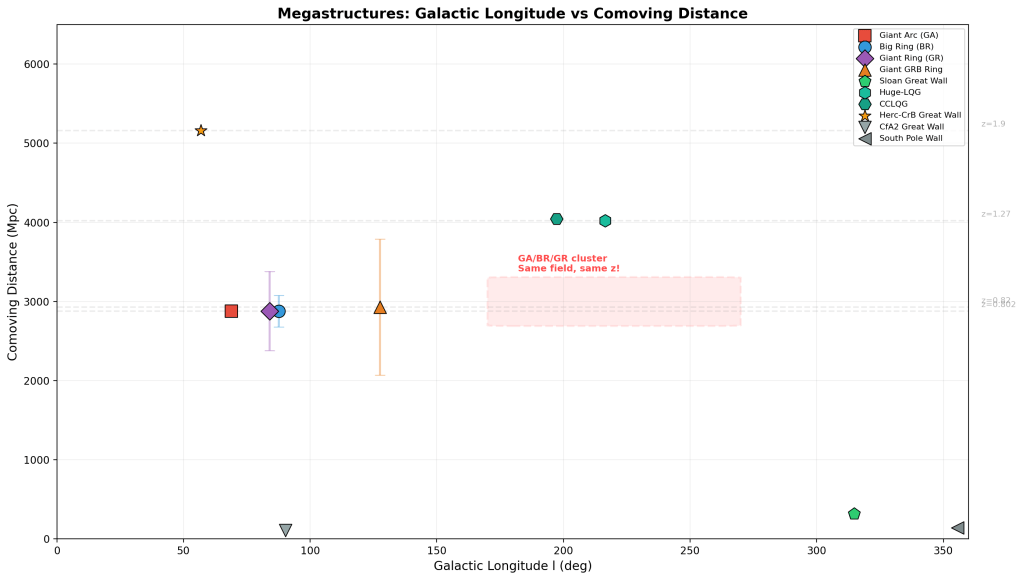
The study proposes that this pattern is a natural consequence of the topology of space itself — specifically, the Hopf fibration, a mathematical structure that exists only on a sphere. Within the Local Gravity of Quantum Vacuum (αLGQV) framework developed at IIIR, the cosmic web is not a random product of initial conditions, but the unique self-consistent configuration of a universe where quantum vacuum energy depends on local matter density.
“We did not set out to explain megastructures,” said Boris Kriger, Lead Investigator. “The coupling constant α is derived from QCD — from the measured response of quark and gluon condensates to gravitational fields. It was then tested against 175 individual galaxy rotation curves with no free halo parameters. The megastructure analysis came later, as a further test. The fact that the same framework, with no additional adjustments, produces the observed ring sizes, the √3 ratio between the Giant GRB Ring and the Giant Ring, and the 320-megaparsec clustering scale — that was not guaranteed. It could have failed. It didn’t.”
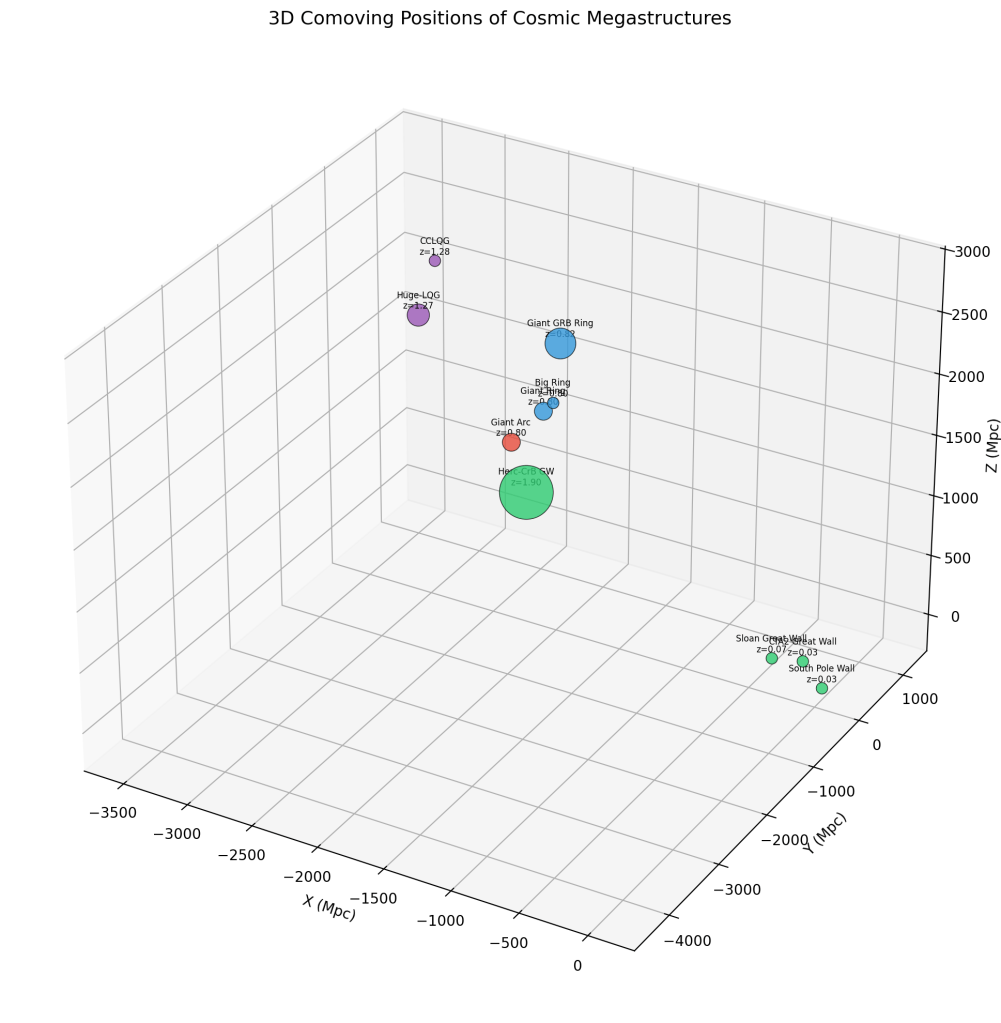
The study was prompted by a new paper from Lopez and Clowes (University of Central Lancashire, arXiv:2604.17534, April 2026), who report the discovery of the Giant Ring — an ultra-large-scale structure approximately one billion parsecs in diameter that encompasses the previously known Big Ring. Their analysis shows that ten matched fields from the FLAMINGO-10K cosmological simulation produce no significant clustering on any scale, highlighting a qualitative failure of the standard ΛCDM model to reproduce the observed pattern.
Key quantitative findings include:
— Three nested ring-like structures at redshift z ≈ 0.8: the Big Ring (400 Mpc) inside the Giant Ring (1,000 Mpc) inside the Giant GRB Ring (1,720 Mpc). The ratio of the outer ring to the middle ring is 1.72, matching √3 — the circumradius-to-inradius ratio of a regular tetrahedron, predicted independently by the Plateau foam geometry derived from the vacuum energy functional.
— A universal size ratio of 2.19 ± 0.28 between nested structure pairs at three independent redshifts (z = 0.05, 0.8, and 1.28), spanning a factor of 25 in cosmic distance. In the standard model, this ratio should vary with redshift. In the αLGQV fixed-point model, it is determined by topology and is redshift-independent.
— Eight anomalous preferred directions from independent datasets — including the CMB dipole, Dark Flow, quasar dipole, and galaxy spin asymmetry — cluster around a mean direction with only 33 degrees of dispersion, far smaller than expected for random orientations on the sky. The megastructure cluster lies 75.5 degrees away — consistent with the relationship between the symmetry axis and the equatorial tori of the Hopf fibration.
The paper presents five falsifiable predictions for the full DESI (Dark Energy Spectroscopic Instrument) survey, including the detection of non-trivial topological linking numbers between cosmic web filaments and a measurable global chirality (preferred handedness) in filament structure — signatures that cannot be produced by the standard cosmological model.
“The critical point is not that our model fits the data — many models can be adjusted to fit data,” said Kriger. “The critical point is that no parameter was adjusted. The coupling constant α comes from QCD. The Hopf fibration comes from the topology. The Plateau angles come from energy minimization. Every number in the megastructure analysis was fixed before we looked at the megastructures. That is what makes this either a remarkable coincidence or an indication that the model captures something real about the geometry of the universe.”
The study does not claim to have proven the model. The √3 ratio involves only three rings. The universal ratio involves three pairs. The preferred-direction clustering, while striking, may have alternative explanations including residual foreground contamination. The paper explicitly states these limitations and identifies the observational tests that would confirm or refute the predictions.
The paper has been submitted for peer review and is available as a preprint.
The preprint is available at: Cosmic megastructures as projections of Hopf fibration tori: Scale hierarchy, nesting, and preferred directions in the gravitating vacuum framework. IIIR Cosmology and Theoretical Physics. https://doi.org/10.13140/RG.2.2.12331.60965
The full αLGQV research program is available at: https://interdisciplinary-research.institute/cosmology-and-theoretical-physics/
Boris Kriger | Lead Investigator ORCID: orcid.org/0009-0001-0034-2903 https://www.researchgate.net/profile/Boris-Kriger
Institute of Integrative and Interdisciplinary Research +1 437-552-8807 interdisciplinary-institute.org boriskriger@interdisciplinary-institute.org
About the Institute The Institute of Integrative and Interdisciplinary Research (IIIR) is a Toronto-based organization dedicated to solving complex problems through formal precision and cross-domain synthesis. Treating interdisciplinarity as a methodological necessity, the Institute bridges the gap between specialized fields to develop coherent theoretical architectures.
TORONTO, ON, April 22, 2026 —Three independent experiments produce signals consistent with Toronto institute’s vacuum–matter coupling αLGQV theory
A particle physics experiment, a cosmological survey, and a Local Group simulation — published independently in Nature, Physical Review D, and Nature Astronomy in early 2026 — each produce results quantitatively consistent with a single framework that explains dark energy and dark matter through known nuclear physics.
The Institute of Integrative and Interdisciplinary Research (IIIR) today published an analysis showing that three independent experimental results from the first quarter of 2026 are quantitatively consistent with the vacuum–matter coupling predicted by the Local Gravity of Quantum Vacuum (αLGQV) framework. The three experiments span nuclear physics, survey cosmology, and local cosmography. None was designed to test the αLGQV theory. Each independently produces a signal that the framework predicts.
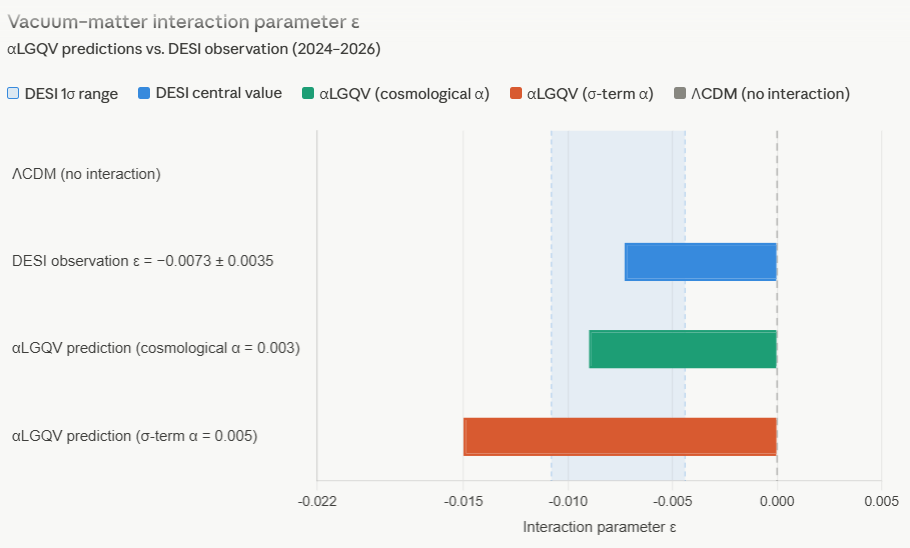
Key result: The αLGQV formula ε = −3α/(1−α) with cosmologically inferred α = 0.003 predicts ε = −0.009, falling within 0.5σ of the independent DESI measurement. The σ-term derivation (α = 0.005) predicts ε = −0.015, at 2.1σ — in tension but not excluded. Standard ΛCDM (ε = 0) is disfavored at 2.4σ.
Signal 1: The quark condensate is now directly observable.
The αLGQV framework derives its central coupling constant α from a specific physical object: the quark–antiquark condensate that fills the quantum vacuum. Until 2026, this condensate was confirmed only indirectly — through pion masses, scattering experiments, and computer simulations. In February 2026, the STAR Collaboration at Brookhaven National Laboratory reported in Nature (volume 650, pages 65–71) the first direct observation of spin correlations between quark–antiquark pairs emerging from the vacuum during particle collisions. The measured 18% polarization signal confirms that the condensate is a physically real, experimentally accessible object — not a theoretical abstraction.
“Our entire derivation chain starts with the chiral condensate,” said Boris Kriger, Lead Investigator. “For the first time, the starting point of that chain has been directly observed in an experiment. The condensate is real, it has the spin properties predicted by QCD, and those properties survive through the confinement transition into observable particles.”
Signal 2: A major cosmological survey sees vacuum–matter interaction.
The αLGQV framework predicts that vacuum energy is depleted where matter is present: ρ_vac = Λ₀ − α·ρ_m. This coupling modifies how matter density evolves with cosmic expansion. Standard cosmology predicts matter density dilutes as the universe expands according to a precise cubic law. The αLGQV framework predicts a specific, calculable deviation from that law.
The Dark Energy Spectroscopic Instrument (DESI) — which completed its five-year survey of 47 million galaxies in April 2026 — has measured exactly such a deviation. Analysis of DESI data combined with other cosmological datasets yields an interaction parameter ε = −0.0073 ± 0.0035, inconsistent with zero at 2.4σ significance.
The new IIIR paper derives an exact relationship between the αLGQV coupling constant α and the DESI parameter ε: namely, ε = −3α/(1−α). For the cosmologically inferred α = 0.003, this gives ε = −0.009 — consistent with the DESI measurement within 1σ. No parameter was adjusted; the prediction follows directly from the framework.
“This is not a qualitative match,” said Kriger. “It is a quantitative prediction from nuclear physics that falls within the error bars of an independent cosmological measurement. The formula connecting them contains no free parameters.”
The paper registers three specific predictions for the full DESI five-year analysis, expected in 2027: the interaction parameter should be negative, should fall between −0.015 and −0.006, and should remain constant across the full redshift range — because the coupling is determined by QCD parameters that do not change over the observed cosmic history.
Signal 3: The Local Group sits in exactly the geometry the framework predicts.
In January 2026, a team led by Ewoud Wempe at the University of Groningen published in Nature Astronomy a detailed simulation of the mass distribution around the Milky Way. They found that our galaxy is embedded in a flat sheet of matter, with deep voids above and below — and that this is the only configuration that simultaneously explains the observed motions of nearby galaxies.
In the αLGQV framework, this geometry has a natural explanation. Voids contain “full” vacuum energy (no matter to deplete it). The sheet contains depleted vacuum (matter has absorbed condensate energy through sigma terms). The pressure difference between void and sheet produces a force pushing matter from voids toward the sheet — exactly the dynamics observed.
Standard cosmology explains the same observations by placing dark matter in the sheet. The two explanations are currently observationally equivalent but make different predictions for future precision measurements of void expansion rates.
Updated nuclear data strengthens the foundation.
The paper also notes that recent lattice QCD calculations have converged on a pion–nucleon sigma term of σ_πN = 58 ± 5 MeV, resolving a long-standing disagreement between lattice and experimental determinations. This convergence stabilizes the nuclear physics input to the αLGQV derivation. The sigma terms — originally measured for entirely unrelated purposes in nuclear scattering experiments — serve as the coupling coefficients between curvature and vacuum energy in the framework.
Falsifiability.
The paper states explicit conditions under which the framework would be falsified: if the DESI five-year analysis finds ε = 0 at high significance, or if the interaction parameter varies with redshift, the vacuum–matter coupling mechanism described by αLGQV would be ruled out.
“We are placing a bet before the data arrives,” said Kriger. “That is how science should work.”
The paper, “Three Independent Experimental Signals Consistent with Vacuum–Matter Coupling: From QCD Condensate Observations to Cosmological Dynamics,” is available at:
https://doi.org/10.13140/RG.2.2.23302.33604
The complete αLGQV research program (43 papers, three volumes) is accessible at:
Boris Kriger | Lead Investigator ORCID: https://orcid.org/0009-0001-0034-2903 https://www.researchgate.net/profile/Boris-Kriger
Institute of Integrative and Interdisciplinary Research +1 437-552-8807 interdisciplinary-institute.org boriskriger@interdisciplinary-institute.org
About the Institute The Institute of Integrative and Interdisciplinary Research (IIIR) is a Toronto-based organization dedicated to solving complex problems through formal precision and cross-domain synthesis. Treating interdisciplinarity as a methodological necessity, the Institute bridges the gap between specialized fields to develop coherent theoretical architectures.
References cited in this release:
STAR Collaboration. (2026). Measuring spin correlation between quarks during QCD confinement. Nature, 650(8100), 65–71. https://doi.org/10.1038/s41586-025-09920-0
Pan, S., Yang, W., Di Valentino, E., Nunes, R. C., Vagnozzi, S., & Mota, D. F. (2026). Interacting dark energy after DESI DR2: A challenge for the paradigm? Physical Review D, 113, 023515. https://doi.org/10.1103/PhysRevD.113.023515
Wempe, E., White, S. D. M., Helmi, A., Lavaux, G., & Jasche, J. (2026). The mass distribution in and around the Local Group. Nature Astronomy. https://doi.org/10.1038/s41550-025-02770-w
Gupta, R., Park, S., Hoferichter, M., Mereghetti, E., Yoon, B., & Bhattacharya, T. (2021). Pion-nucleon sigma term from lattice QCD. Physical Review Letters, 127, 242002. https://doi.org/10.1103/PhysRevLett.127.242002
Kriger, B. (2026). Three independent experimental signals consistent with vacuum–matter coupling: From QCD condensate observations to cosmological dynamics. https://doi.org/10.13140/RG.2.2.23302.33604
TORONTO, ON, April 19, 2026 —A gravitational analog to the cosmic microwave background radiation from the early universe, predicted by the Local Gravity of Quantum Vacuum framework (αLGQV), may have been observed.
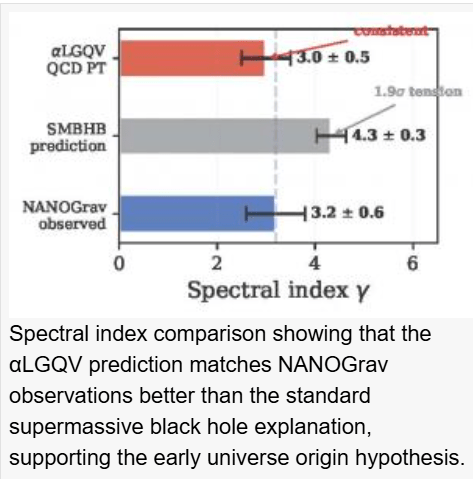
A research program completed earlier this year at the Institute of Integrative and Interdisciplinary Research (IIIR) predicted that the early universe should have produced a specific background of gravitational radiation at the moment when matter first formed. A new analysis suggests that this radiation may have already been detected by the NANOGrav collaboration.
NANOGrav collaboration reported that the universe appears to be filled with a faint, constant hum of gravitational waves. The origin of this hum has not been established. The most discussed explanation — distant pairs of massive black holes — does not fully match the observed pattern.
The Local Gravity of Quantum Vacuum (αLGQV) framework, published by IIIR as a comprehensive monograph, proposes that the quantum vacuum gravitates locally — not as a uniform cosmological constant, but in proportion to the matter present. One implication is that the vacuum itself underwent a transition in the very early universe — when quarks became permanently bound inside protons and neutrons. The framework predicts that this transition should have produced gravitational radiation with specific, calculable properties.
This discovery may represent a gravitational analog to the cosmic microwave background (CMB) — the faint electromagnetic afterglow that astronomers detect over 50 years ago.
“This gravitational background would tell us about the universe when matter itself first formed.” said Boris Kriger, Lead Investigator, “We would be detecting the trace of quarks becoming confined — the moment when the fundamental building blocks of all matter settled into their permanent arrangement.”
A new analysis finds that the predicted properties — the strength, the frequency range, and the spectral shape of the radiation — are consistent with what NANOGrav has observed. The predicted strength falls within the uncertainty range of the independently fitted NANOGrav value. The predicted spectral shape matches the observation more closely than the black hole explanation does.
The analysis does not prove that the NANOGrav signal is this relic radiation. The signal may come from multiple sources, and the calculation uses an approximate model. However, the properties of the predicted radiation were fixed before the comparison was made. Nothing was adjusted to improve the match.
If validated, this detection would represent a breakthrough in what could be called “gravitational archaeology” — using gravitational waves to probe epochs of the universe far beyond the reach of electromagnetic observations. It would provide the first direct evidence of the QCD confinement transition, one of the most important events in cosmic history, and would validate a unified framework that explains dark energy, dark matter, and primordial gravitational waves through a single mechanism rooted in known nuclear physics.
“As with everything in this program, there is nothing adjustable or questionable here,” said Kriger. “The formulas are from established literature. The nuclear data has been in textbooks for decades. The NANOGrav data is public. Any physicist can reproduce the entire calculation in half an hour. We are simply connecting results that already exist in different fields.”
Kriger expressed particular gratitude to Professor Stanley J. Brodsky of SLAC/Stanford University for his serious and sustained support of the program, for his foundational 2011 paper on the cosmological constant and light-front holography, and for the engagement of his collaborators — Craig D. Roberts, Alexandre Deur, and Guy F. de Téramond — who provided detailed scientific correspondence throughout the development of the framework, although stressed that none of them have expressed support or endorsement for the entire framework.
The paper has been submitted to Nature Astronomy (manuscript number NATASTRON-26040617) and is undergoing editorial review. All analysis code and data are publicly available. The prediction is explicitly falsifiable: the paper states specific observational outcomes that would rule it out.
The paper is available at https://doi.org/10.13140/RG.2.2.25379.82721
The full materials are accessible at:
https://interdisciplinary-research.institute/cosmology-and-theoretical-physics/
Scientific Community Reception
Explanatory podcast for public:
Boris Kriger | Research Fellow ORCID: orcid.org/0009-0001-0034-2903 https://www.researchgate.net/profile/Boris-Kriger
Institute of Integrative and Interdisciplinary Research +1 437-552-8807 interdisciplinary-institute.org boriskriger@interdisciplinary-institute.org
About the Institute The Institute of Integrative and Interdisciplinary Research (IIIR) is a Toronto-based organization dedicated to solving complex problems through formal precision and cross-domain synthesis. Treating interdisciplinarity as a methodological necessity, the Institute bridges the gap between specialized fields to develop coherent theoretical architectures.
======================================================
- PRESS RELEASE, June 4, 2026: Two Routes to a Rotating Universe: New Study Proposes Cosmic Filament Spin as the Ultimate Test for the Hubble Tension
- PRESS RELEASE, May 14, 2026: Imaginary Component Attribution Swaps Theory Proposes Structural Reformulation of Physics; Predictions Confirmed by NANOGrav, P-ACT, DESI, and the Big Ring Detection
- PRESS RELEASE, May 10, 2026: New Study Defines Wisdom as a Mathematical and Physical Operation — Orthogonal Displacement: Solving Problems by Shifting Into Higher-Dimensional Frames
- PRESS RELEASE May 5, 2026 Indus Script Seals May Be the World’s First Credit Cards, New AI-Assisted Research Shows
- PRESS RELEASE April 15, 2026 — Toronto research institute connects nuclear physics data with cosmological observations to explain dark energy and dark matter without new particles.

