
A new paper from the Institute of Integrative and Interdisciplinary Research proves that the sign alternation of the vacuum follows from global neutrality and entanglement with a time-reversed partner, computes that the antipode of an elliptic universe, taken as a distant image, contributes one part in 10⁸⁵ at nuclear distances, and shows that the proton is a closed core of radius 0.68 fm wrapped in a layer of displaced vacuum of radius 1.22 fm.
Preprint: Why the Vacuum Fluctuates and the Baryon Does Not: Time-Reversed Partners, Antipodal Pairing on Elliptic Space, and Closure as the End of Fluctuation https://doi.org/10.13140/RG.2.2.31271.30883
Companion note: What a Screened Scalar Sees of a Skyrmion: The σ-Term Density, the Trace Tail, and the Bag Hidden in the Hard Sphere https://doi.org/10.13140/RG.2.2.35255.89766
TORONTO, ON, November 7, 2026 — Ask a physicist why the vacuum fluctuates and the textbook answer is that it does not, strictly speaking, do anything: the vacuum is a stationary state, and its “fluctuations” are variances that follow from the fact that field operators do not commute with the energy. The answer is correct for the vacuum taken as a whole. It says nothing about why anything in the vacuum should alternate — why a region should find itself now with one sign of charge and now with the other — and nothing about why some things in the vacuum, protons above all, never alternate at all. A paper released this week by Boris Kriger, Lead Investigator at the Institute of Integrative and Interdisciplinary Research (IIIR), takes up the question in that sharper form and answers it with results that hold independently of any cosmological model.
Four results that do not depend on the model
The paper proves four general statements. First, in any pure state of total charge zero, the partners of a region in its entanglement decomposition carry opposite charges, so the charge of any entangled region has zero mean and positive variance: alternation of sign is the local image of global neutrality together with entanglement. Second, an entangled state can be stationary only under a flow that runs the region forward and its partner backward. The partner’s time is reversed. This is the structure behind the thermal effects found by Unruh, Israel, Bisognano and Wichmann, and Gibbons and Hawking, which the paper reads as the only settings in which the fluctuations of a region are derived rather than postulated. Third, on an elliptic universe, where every point is identified with its antipode and charge conjugation is built into the identification, the total charge vanishes identically and the global time-reversed partner of every point is its antipode. Fourth, a closed configuration does not fluctuate: an integer topological charge cannot be changed by any continuous, finite-energy deformation, so its variance is zero.
A number that rules out the easy reading
If the antipode of an elliptic universe acted as an ordinary distant image, how much would it contribute to local physics? The paper computes it. For the closed curvature preferred by the Planck satellite data alone, the antipodal image carries a fraction of about 4–6 × 10⁻⁸⁵ of local correlations at one femtometre, 10⁻⁵⁵ at one metre, and reaches 10⁻⁴ only at gigaparsec scales. The antipodal reading of vacuum fluctuations therefore survives only in a stronger form, the same point read along the opposite arrow, and the paper states this as an explicit fork rather than an assumption. It then reduces the fork to a finite calculation: the canonical purification of a density matrix always supplies an anti-copy with opposite charges and reversed time, and a recent result by Dulac and Wei shows that the elliptic de Sitter universe is described by exactly such a density matrix. Whether its anti-copy is a second universe or the universe itself can be decided in their two-dimensional model.
Why the proton does not fluctuate
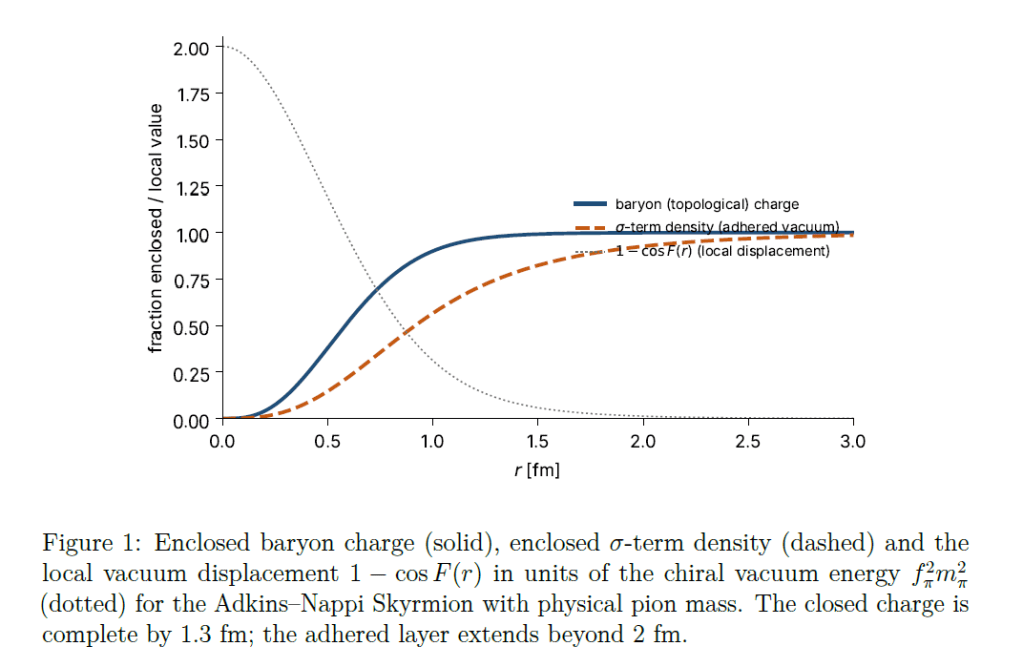
The proton is the clearest case on both sides of the question. Solving the Skyrme model with physical pion mass, the paper shows that the baryon charge sits in a closed core with a root-mean-square radius of 0.68 fm, 98% of it inside 1.33 fm. The vacuum displaced by the nucleon, which by the Gell-Mann–Oakes–Renner relation is exactly the pion–nucleon σ-term density, forms a layer with a root-mean-square radius of 1.22 fm, a quarter of it beyond 1.33 fm. The nucleon is a non-fluctuating closed core wrapped in a fluctuating layer of adhered vacuum. The σ-term measures the second part; baryon number measures the first. The proton-decay limit from Super-Kamiokande, more than 2.4 × 10³⁴ years, is the empirical statement that the closed part has no measurable variance.
The paper also explains why the neutron, neutral overall, holds as much vacuum as the proton. If the holding were set by electric charge, the neutron would hold 20–33% less; the measured neutron–proton mass difference leaves room for an electric share of at most about 10%. The holding is set by color, which every quark carries with the same magnitude.
How matter forms
If fluctuation is the mark of an open configuration, the formation of matter is the closing of fluctuations. The paper treats it as a Kibble–Zurek freeze-out, with the velocity of time of the programme’s Carrollian initial state as the control parameter. The velocity at which the fate of particle–antiparticle pairs is decided then becomes a derived freeze-out value rather than an input, and the programme’s survival law for the baryon asymmetry coincides with the Kibble–Zurek density of closures only if the correlation-length exponent equals 2/3. The best-known reference value, from the O(4) class of the chiral transition, misses this by twelve percent, a definite test for the programme’s own dynamics.
The companion note: a nucleon is not a hard sphere
The companion note responds to Brax, Burrage and Moss (arXiv:2611.02213), who replaced the hard-sphere nucleon of laboratory fifth-force analyses by a Skyrmion and found exclusion limits shifted by up to three decades. The note shows that the hard sphere they replace is exactly the source of the MIT bag model, so that the comparison is between a nucleon closed behind a wall and one closed by internal balance with no surface, and computes that a scalar field coupled to quark masses would have a half-screening scale of 3.62 MeV × (σ_πN/MeV)^½. Deep in screening, where the published gains lie, a screened scalar reads the adhered layer of the nucleon, not its core.
In the words of the author
“Physics has a good answer to why the vacuum has variances and almost no answer to why anything in it alternates,” said Boris Kriger. “The answer turns out to be the same structure that makes horizons hot: every region is entangled with a partner whose time runs the other way. On an elliptic universe that partner is the universe itself. And the question that looked like an objection — why doesn’t the proton fluctuate? — turned out to be the definition. The vacuum fluctuates because it is open. The proton does not, because it is closed.”
Falsifiability and limitations
The general theorems are proved in finite or countable dimension and extended to field theory by standard methods; for bounded regions the reversed partner is reversed in the modular sense only. The identification of the antipode with the same point read along the opposite arrow is stated as an identification, and the paper reduces it to a calculation it does not perform. The nucleon radii come from the leading-order Skyrme model, whose σ-term (37.7 MeV) lies below the measured range. The Kibble–Zurek comparison depends on exponents the programme has not yet computed and on the choice of control parameter; both natural choices are stated. Each of these is stated in the paper as a fork, with both branches developed.
An invitation
The Institute invites specialists in algebraic quantum field theory, de Sitter quantum gravity, chiral soliton models and critical dynamics to scrutinize and test the results. The calculation that decides the central fork, the modular conjugation of the elliptic no-boundary density matrix, is finite and well posed. Researchers interested in performing it, or in repeating the core–layer separation with quantized nucleons or multi-baryon Skyrmions, are invited to contact the Institute directly at boriskriger@interdisciplinary-institute.org
Preprint: https://doi.org/10.13140/RG.2.2.31271.30883
Companion note: https://doi.org/10.13140/RG.2.2.35255.89766
Full αLGQV programme: interdisciplinary-research.institute/cosmology-and-theoretical-physics
Reception and correspondence: interdisciplinary-research.institute/reception
Boris Kriger | Lead Investigator ORCID: orcid.org/0009-0001-0034-2903 Institute of Integrative and Interdisciplinary Research, Toronto +1 437-552-8807 · boriskriger@interdisciplinary-institute.org
About the Institute
The Institute of Integrative and Interdisciplinary Research (IIIR) is a Toronto-based organization dedicated to solving complex problems through formal precision and cross-domain synthesis. Treating interdisciplinarity as a methodological necessity, the Institute bridges specialized fields to develop coherent theoretical architectures.


Leave a Reply