
PRESS RELEASE. TORONTO, ON, October 26, 2026 — The universe began without time and without gravitation: a new monograph describes the initial state as energy before it has any form, and turns its consequences into twenty measurable predictions
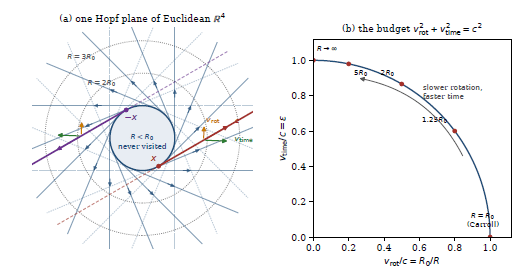
The eighth volume of the αLGQV programme finds the beginning of a counter-rotating elliptic universe to be a Carrollian state, in which time does not flow. It writes the whole model as a single action in which gravitation switches on only when the vacuum’s quark condensate forms. The volume closes with a matrix of tests against the standard model, inflation and modified Newtonian dynamics.
The Institute of Integrative and Interdisciplinary Research has published The Carrollian Initial State Cosmology: Energy, Topology and Time in a Counter-Rotating Elliptic Universe (Volume VIII of the αLGQV monograph series, 447 pp.).
https://doi.org/10.13140/RG.2.2.18101.84968
The monograph starts from the counter-rotating elliptic model, in which the universe is the three-sphere with antipodal points identified (RP³). At the beginning this space is filled with quarks, gluons and vacuum at about five times nuclear density and rotates at the speed of light. The volume shows that this state is, mathematically, a Carrollian manifold: the limit of relativity in which the effective speed of light goes to zero and time does not flow. It then asks what such a state is, and answers that it is what physics calls energy, taken before it has any form.
What the volume establishes
- A beginning without a first instant. The initial state carries two integers, has no instant from which time could be counted, and leaves equilibrium irreversibly, with two opposite arrows of time.
- Energy before time. In the local algebra of the initial state the Hamiltonian is central. Energy exists but generates no motion, and time begins when it ceases to be central.
- A quarter of the energy released. Conservation of angular momentum allows only one quarter of the initial energy to be released at confinement. The first temperature of the universe is therefore 110–126 MeV, below the QCD crossover.
- The vacuum as a medium. The vacuum is described as a Maxwell viscoelastic medium. It is elastic for gravitational waves and flows under the slow cosmological stretch, with a relaxation time of 7.7–8.7 billion years.
- One action. The whole model is written as one action in which Newton’s coupling depends on the chiral condensate, G_eff = G(σ/f_π)^{3/2}. Gravitation is absent at the beginning and switches on as the condensate forms at the first actualization. The same relation expresses Newton’s constant through the pion mass, the pion decay constant and the memory of the vacuum’s network, which gives a mechanism for Dirac’s large-number coincidence.
- A keystone for the programme. The volume shows which inputs of the other volumes become consequences of the initial state, among them the form of the vacuum–matter coupling α_V ≈ 0.005 and the finite-density cores that replace singularities.
Falsifiable predictions
The volume ends with an observational manifesto of twenty statements, each with the measurement that decides it and the result that would refute it. Among them:
- Primordial tensors: r ≈ 0. A detection by LiteBIRD or CMB-S4 refutes the model’s account of the beginning.
- Dark energy: w ≥ −1 at every redshift, with no phantom crossing.
- Gravitational-wave distances: distances measured from gravitational waves exceed electromagnetic ones by 1.35–1.40 at redshift 0.5 and 1.59–1.67 at redshift 1, independently of frequency. This is testable with standard sirens from the Einstein Telescope, Cosmic Explorer and LISA.
- Dark matter: no dark-matter particle accounts for the missing mass.
- Curvature: a closed spatial curvature of at most a few thousandths.
Limitations stated in the volume
The monograph does not generate the primordial spectral index n_s, which remains an input, as in the standard model. The deconfinement density is an estimate. Several questions are reduced to forks whose deciding measurements are named rather than settled.
“The textbooks define energy as the capacity to do work or as what is conserved because the laws do not change in time. Both definitions presuppose time,” said Boris Kriger, Lead Investigator. “This book follows the universe back to a state that has no time, and asks what energy is there. Every step is set out with both of its alternatives, every input with its status, and every computable claim with the code that checks it.”
Publication
Kriger, B. (2026). Volume VIII. The Carrollian initial state cosmology: Energy, topology and time in a counter-rotating elliptic universe [Monograph, 447 pp.]. IIIR Cosmology and Theoretical Physics. ISBN 9798165637964. https://doi.org/10.13140/RG.2.2.18101.84968
Programme page: https://interdisciplinary-research.institute/cosmology-and-theoretical-physics/
Boris Kriger
Lead Investigator
ORCID: orcid.org/0009-0001-0034-2903
ResearchGate: https://www.researchgate.net/profile/Boris-Kriger
Institute of Integrative and Interdisciplinary Research, Toronto
+1 437-552-8807
interdisciplinary-institute.org
boriskriger@interdisciplinary-institute.org
About the Institute
The Institute of Integrative and Interdisciplinary Research is a Toronto-based research organization that addresses complex problems by combining rigorous formal methods with work across disciplines. It treats interdisciplinary integration as a methodological requirement, connecting specialized fields into coherent theoretical frameworks.


Leave a Reply