
PRESS RELEASE. TORONTO, ON, September 30, 2026 — Does the magnetar 1E 1547.0−5408 show empty space bending light? A proof of which measurement can decide, and a first answer
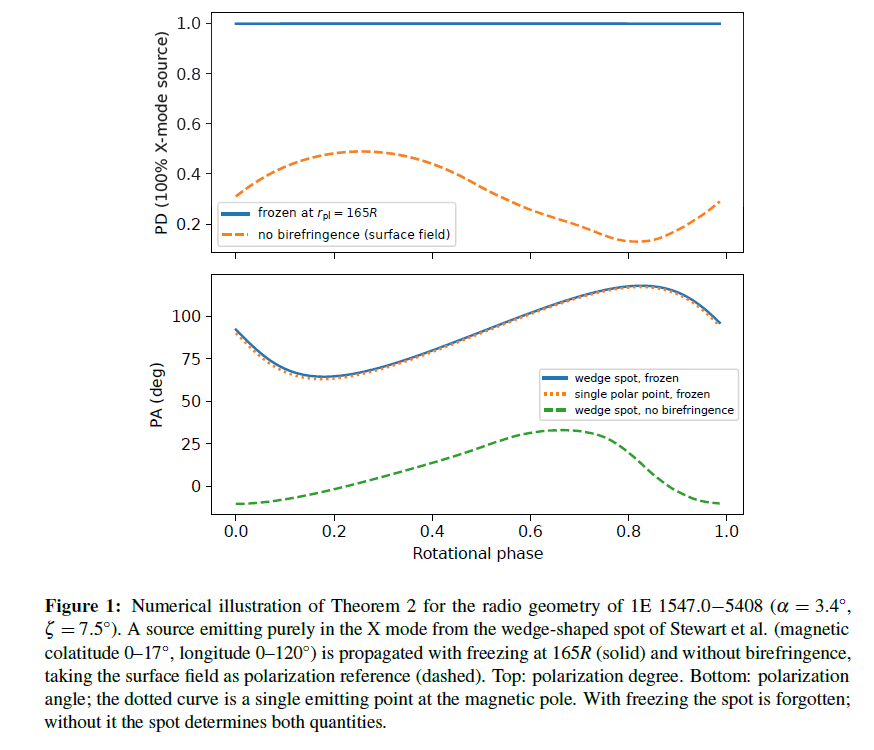
In August, a team using NASA’s IXPE telescope reported in Nature that the magnetar 1E 1547.0−5408 may be showing vacuum birefringence: empty space, strained by a magnetic field hundreds of trillions of times stronger than Earth’s, changing the polarization of light passing through it. A second team analysing the same data found that the polarization could be explained with or without the effect. A new study from the Institute of Integrative and Interdisciplinary Research shows why the two analyses disagree, proves which measurement can decide the question independently of the unresolved hot spot on the star, and finds that this measurement currently points to a magnetic geometry different from the one seen in the radio.
Preprint: Where the polarization freezes: A spot-independent test of vacuum birefringence in the IXPE magnetars. IIIR Cosmology and Theoretical Physics. https://doi.org/10.13140/RG.2.2.29943.38567
Vacuum birefringence was predicted by Werner Heisenberg and Hans Euler in 1936. In a strong enough magnetic field, the quantum vacuum gives light two different refractive indices depending on its polarization. Laboratory experiments have pursued the effect for a quarter of a century without reaching it. Magnetars, neutron stars with the strongest magnetic fields known, are the only places in nature where the field is strong enough. The price is that the hot spot on the star’s surface that emits the X-rays cannot be resolved.
That hot spot is where the disagreement lives. The Nature team (Stewart et al. 2026) modelled an extended spot and found that without vacuum birefringence the polarization would wash out. The Padova team (Taverna et al. 2026, The Astrophysical Journal) modelled a small spot and found almost no difference with or without the effect. Both models fit the data. The new study proves that in this situation the conclusion is carried by the choice of spot, not by the measurement.
Why this matters beyond magnetars
The structure of this disagreement will be familiar to cosmologists: one data set, several analyses, opposite conclusions, and the decisive input being a modelling choice the data cannot fix. The same pattern runs through debates on the Hubble tension and on evolving dark energy. The magnetar case is unusually clean, because the physics of propagation is textbook and the disputed element can be named. It therefore offers a worked example of how to find the observable that does not depend on the disputed choice, and how to pre-register a test before new data arrive.
What the study shows
The study re-analyses all seven public IXPE observations of magnetars with an independent, fully published pipeline that reproduces the published results, and derives the star’s rotation from the X-ray photons alone. It then proves four results.
First, around every magnetar observed so far, the vacuum steers the polarization of X-rays out to between about seventy and more than a thousand stellar radii before letting go. In these objects vacuum birefringence is not marginal; it is overwhelming.
Second, once the vacuum has steered the light that far, the polarization angle forgets where on the surface the light came from, up to an explicit bound of a few degrees. The polarization degree, the quantity at the centre of the published claims, then measures the atmosphere of the star, not the vacuum.
Third, the swing of the polarization angle as the star rotates measures essentially one geometric number, the ratio of the sines of two angles. Three separate analyses of the same X-ray data, including that of the Nature team and a group in China, obtain the same value: about 0.30–0.33.
Fourth, the reported dip in polarization between 3 and 4 keV, a possible signature of quantum electrodynamics in the star’s atmosphere, falls from about 2.9 to about 2.3 standard deviations once one accounts for the energy window having been chosen after looking at the data.
The result
If the vacuum steers the light as quantum electrodynamics predicts and the field is a simple dipole, the X-ray and radio polarization angles of this star must trace the same geometry, whatever the hot spot looks like. They do not. The radio gives 0.454 for the geometric ratio; the X-rays give 0.30 ± 0.04, a difference of about 3.3 standard deviations from the X-ray uncertainty alone. Under vacuum birefringence, a hot spot displaced from the magnetic pole cannot account for this offset in the polarization angle.
“Nobody doubts that the vacuum is birefringent; that is textbook quantum electrodynamics,” said Boris Kriger, Lead Investigator. “The question was whether this star shows it in a way an unseen hot spot could not imitate. The polarization degree cannot answer that. The polarization angle can, because the vacuum erases the spot from it. And the angle is telling us that the field a hundred stellar radii out is not the one the radio sees: a twisted magnetosphere, a radio beam that does not follow the dipole, or plasma competing with the vacuum. Each of these can be tested.”
The vacuum as a medium
Popular accounts describe the magnetized vacuum as “crystallized.” The mathematics says otherwise: the vacuum acquires a direction without acquiring a lattice, the symmetry of a liquid crystal rather than a solid. The place where it stops steering light is not a sharp surface but a gradual transition, governed by the ratio between how fast the medium responds and how fast the field turns along the light’s path.
Pre-registered tests
IXPE has accepted a one-million-second observation of the same star, about twice as deep as the first. So that the choice of analysis cannot decide the outcome again, the study fixes four tests in advance, with energy windows, statistics and thresholds stated before the data exist. Three of the four do not depend on the hot spot.
Limitations
The study uses a deliberately simple reduction pipeline, fully published. The radio uncertainty on the geometric ratio has not been released, so the 3.3-sigma figure is preliminary. The sample contains six magnetars. The study does not model stellar atmospheres and does not claim that vacuum birefringence is absent.
An invitation.
The Institute invites X-ray and radio astronomers, theorists of neutron-star magnetospheres, and cosmologists interested in the statistics of model-dependent inference to scrutinize, reproduce and test the results. All code is included in the preprint and runs on public archive data. Researchers interested in collaboration are invited to contact the Institute directly at boriskriger@interdisciplinary-institute.org.
Preprint: Where the polarization freezes: A spot-independent test of vacuum birefringence in the IXPE magnetars
https://doi.org/10.13140/RG.2.2.29943.38567
Full αLGQV programme:
References cited in this release:
Stewart, R. E., et al. (2026). Vacuum birefringence and the polarized X-ray emission from a radio magnetar. Nature, 656, 590–594. https://doi.org/10.1038/s41586-026-10859-z
Taverna, R., Turolla, R., et al. (2026). The long quest for vacuum birefringence in magnetars: 1E 1547.0-5408 and the elusive smoking gun. The Astrophysical Journal, 1002, 102.
Li, B.-P., Gao, Z.-F., Ma, W.-Q., & Zhang, W.-F. (2026). Probing the origin of magnetar X-ray polarization diversity. arXiv:2604.10477.
Heisenberg, W., & Euler, H. (1936). Folgerungen aus der Diracschen Theorie des Positrons. Zeitschrift für Physik, 98, 714–732.
Boris Kriger | Lead Investigator
ORCID: orcid.org/0009-0001-0034-2903
https://www.researchgate.net/profile/Boris-Kriger
Institute of Integrative and Interdisciplinary Research, Toronto
+1 437-552-8807 · boriskriger@interdisciplinary-institute.org
About the Institute
The Institute of Integrative and Interdisciplinary Research (IIIR) is a Toronto-based organization dedicated to solving complex problems through formal precision and cross-domain synthesis. Treating interdisciplinarity as a methodological necessity, the Institute bridges specialized fields to develop coherent theoretical architectures.


Leave a comment