
Indus Script Seals May Be the World’s First Credit Cards, New AI-Assisted Research Shows
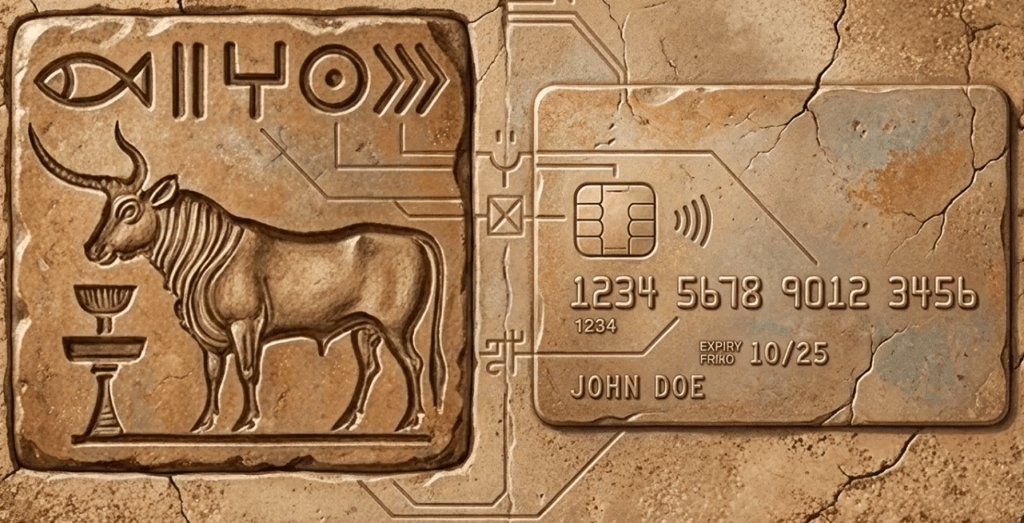
A three-paper research programme from the Institute of Integrative and Interdisciplinary Research demonstrates that the undeciphered Indus script functions as a structured registration code — and proposes that the seals served as institutional credit instruments in the world’s first cashless transaction system. The finding reframes both the century-long Indus script debate and the history of money.
Paper 1: Kriger, B., & Hunt, T. A. (2026). Positional constraints, sequence uniqueness, and stroke numerals in Indus seal inscriptions from Mohenjo-Daro: a statistical analysis. IIIR Computational Humanities and Cultural Systems. https://doi.org/10.5281/zenodo.19103880
Paper 2: Kriger, B. (2026). What would prove it? Definitional indeterminacy, methodological undecidability, and a decision framework for the Indus sign system. Computational Linguistics. Preprint Manuscript No. 3703. https://philpapers.org/rec/KRIWWP
Paper 3: Kriger, B. (2026). The Credit Cards of the Bronze Age: Indus Seals and the Origins of Institutional Credit. IIIR Computational Humanities and Cultural Systems. https://doi.org/10.5281/zenodo.20040472
The Indus Valley Civilization (c. 2600–1900 BCE) was the largest Bronze Age civilization on Earth — spanning approximately one million square kilometers across what is now Pakistan and northwestern India, with standardized weights, uniform urban planning, and long-distance trade reaching Mesopotamia, Central Asia, and the Persian Gulf. Yet it produced no coinage. For a century, scholars attempted to decipher the short inscriptions on its stamp seals by searching for the language encoded within. All attempts failed.
This research programme proposes that the failure was not due to insufficient data but to an incorrect assumption. The seals were never linguistic writing. They were structured registration codes — and they functioned as institutional credit instruments.
The statistical foundation
Using AI-assisted computation (Claude Opus 4.6, Anthropic), the first positional entropy analysis of Indus seal inscriptions was performed on a controlled subcorpus of 179 Mohenjo-Daro unicorn seals. Five findings emerged:
- 98.3% of all seal inscriptions are unique sign sequences — statistically impossible under random assignment (permutation test, p < 0.001) and far exceeding what personal names or commodity labels would produce.
- Positional entropy varies significantly across sign positions: constrained at the edges, diverse in the middle (Friedman test, χ²(4) = 14.7, p = 0.005) — the signature of a formatted code, not natural language.
- Stroke-numeral signs constitute 15.4% of the corpus and cluster in the penultimate position — exactly where a quantity or tier field would sit in a modern identification number.
- The digit “2” accounts for 66.9% of all numerals (χ²(4) = 198.3, p < 0.001 against uniform) — a distribution consistent with a tiered membership system, not natural-quantity encoding.
- Eight near-duplicate pairs differ by exactly one sign, with variation restricted to middle positions, never edges (p = 0.008) — confirming that the format protects category markers while varying individual identifiers.
The methodological framework
The second paper demonstrates that the century-long impasse reflects two compounding failures: the term “script” was never precisely defined, and statistical methods alone cannot resolve the linguistic question. A Decision Framework comprising six testable predictions is proposed. Across all six tests, the administrative-code hypothesis generates predictions that are confirmed or untested, while the linguistic hypothesis produces multiple anomalies.
The credit-instrument hypothesis
The third paper identifies the economic function of the registration codes. The Indus seal satisfies every definitional condition of a credit instrument: unique identifier, institutional issuance, transactions without immediate value transfer, institutional guarantee of settlement, and non-transferability. The structural correspondence with pre-chip embossed credit cards is exact — intaglio carving produces clay impressions precisely as embossed numbers produce carbon-paper slips. Both systems separate the instrument (carried by the bearer) from the record (retained by the counterparty), enabling deferred institutional clearing.
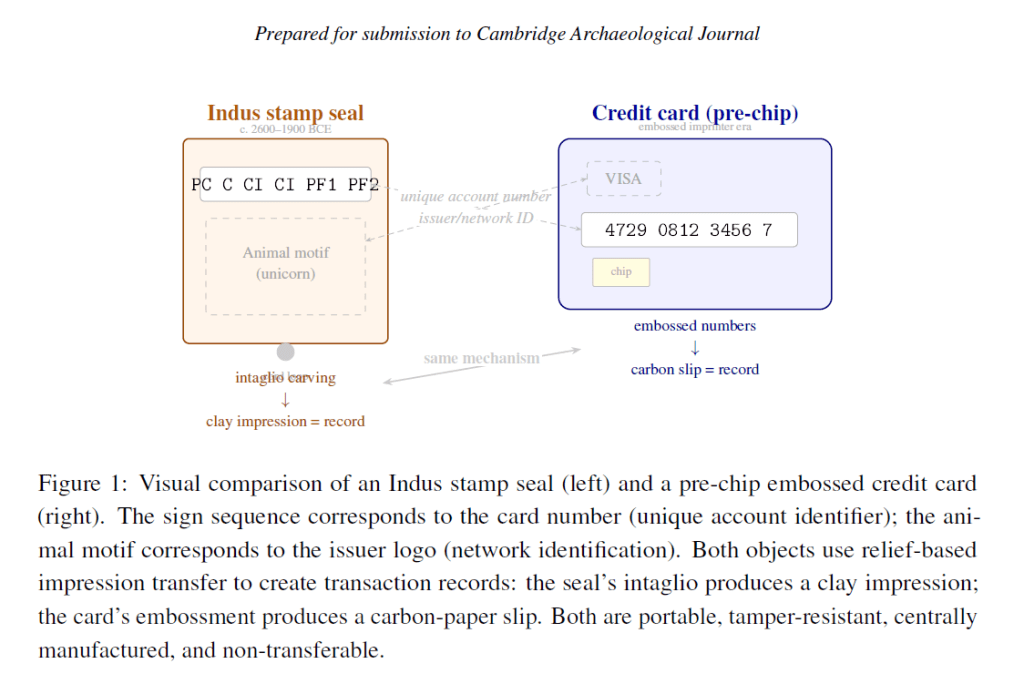
“For a century, we searched for the language inside the seals,” said Boris Kriger, Lead Investigator. “The seals were never encoding language. They were encoding credit. The sign sequence is an account number. The animal motif is an issuer logo. The clay impression is a transaction slip. The guild settles later. This is not a metaphor — it is a mechanical description. The Indus civilization invented institutional credit four thousand years before Visa.”
https://youtu.be/hUPnm2AvgI8?si=0XlkdcTGOD0Ot8O0
The phonetic reconciliation
The codes were spoken aloud — a merchant needed to relay her account number to a scribe, across a warehouse, for inclusion in a ledger on a palm leaf. Asko Parpola’s Proto-Dravidian readings may capture genuine phonetic traditions used by real speakers in specific regions and periods. But the vocalization was not what the code encoded — just as the @ symbol is pronounced differently in every language without its function changing. The credit-instrument hypothesis does not displace phonetic research; it shows that phonetic readings capture one layer of a multi-layered system.
The absence of written records. The near-complete absence of Indus documents is consistent with a credit system that recorded transactions on perishable media — palm leaves, birch bark, cotton cloth — the standard writing surfaces of South Asian civilizations throughout recorded history. What survives is the credit cards. The transaction slips rotted away four thousand years ago.
Reconciliation of previous approaches
The programme reconciles rather than replaces a century of scholarship. Parpola’s phonetic readings capture genuine vocalization traditions. Farmer, Sproat, and Witzel’s non-linguistic characterization is confirmed at the system level. Mukhopadhyay’s administrative interpretation — taxation, licensing, commodity control — receives independent statistical validation; these are precisely the functions that registration-based credit instruments serve. Rao and Yadav’s entropy analysis is extended from aggregate to positional level. Every cited researcher found a genuine piece of the puzzle. The contribution of this programme is the statistical and economic framework that shows how the pieces fit together.
Tamil Nadu continuity
A 2025 study commissioned by the Government of Tamil Nadu (Rajan & Sivanantham) found that 60% of graffiti marks on ancient pottery across 140 Tamil Nadu sites share morphological parallels with Indus signs. The credit-instrument hypothesis explains this as administrative continuity — the same marking tradition persisting for over a thousand years after the Indus cities fell.
What we do not know
We do not know what language the Indus people spoke. We do not know what individual signs mean. We do not know the specific names of the guilds, the commodities, or the people who carried these seals. We have identified the system’s architecture and its economic function, not its content. The format is the finding.
Falsifiable predictions
The hypothesis specifies testable predictions: (1) cross-site replication of the uniqueness and entropy profiles on the full corpus (~5,500 inscriptions); (2) different animal motifs should correspond to different sign vocabularies if they function as issuer logos; (3) clay sealings at port sites should show multi-party impressions consistent with transaction authorization; (4) duplicate seals should differ in manufacturing details, confirming reissuance; (5) the algebraic substitution test should produce incoherent results for any putative linguistic reading across multiple inscriptions.
The Indus Script: How AI Helped to Understand a 4,000-Year-Old Information System
https://medium.com/@krigerbruce/the-indus-script-2f584ed9e2f8
AI-assisted computation
Statistical computations were performed using Claude Opus 4.6 (Anthropic, released 5 February 2026) as a computational tool. The AI retrieved the corpus from GitHub, wrote and executed all Python analysis scripts, and produced all statistical results. It also identified an anomalous sign classification (P120) not anticipated by the human researcher. All hypotheses, interpretations, and claims are the sole responsibility of the human authors. The corpus is open-access. The analysis code uses only Python’s standard library. Every result is reproducible by any researcher in minutes.
The Iravatham Mahadevan Prize
In January 2025, Tamil Nadu Chief Minister M.K. Stalin announced a prize of US$1 million — named after epigraphist Iravatham Mahadevan (1930–2018) — for the decipherment of the Indus script. The present research programme may be considered relevant to that prize. We propose that recognition be shared among all research groups whose contributions made it possible, with each group directing its share toward continuation of Indus script research.
Papers:
Kriger, B., & Hunt, T. A. (2026). Positional constraints, sequence uniqueness, and stroke numerals in Indus seal inscriptions from Mohenjo-Daro: a statistical analysis. IIIR Computational Humanities and Cultural Systems. https://doi.org/10.5281/zenodo.19103880
Kriger, B. (2026). What would prove it? Definitional indeterminacy, methodological undecidability, and a decision framework for the Indus sign system. Computational Linguistics. Preprint Manuscript No. 3703. https://philpapers.org/rec/KRIWWP
Kriger, B. (2026). The Credit Cards of the Bronze Age: Indus Seals and the Origins of Institutional Credit. IIIR Computational Humanities and Cultural Systems. https://doi.org/10.5281/zenodo.20040472
The Indus Script Project: https://interdisciplinary-research.institute/humanities_programs/
Open data: https://github.com/mayig/indus-valley-script-corpus (CC-BY-4.0)
Boris Kriger | Lead Investigator ORCID: https://orcid.org/0009-0001-0034-2903
Institute of Integrative and Interdisciplinary Research Toronto, Ontario, Canada +1 437-552-8807 interdisciplinary-institute.org boriskriger@interdisciplinary-institute.org
About the Institute The Institute of Integrative and Interdisciplinary Research (IIIR) is a Toronto-based organization dedicated to solving complex problems through formal precision and cross-domain synthesis. Treating interdisciplinarity as a methodological necessity, the Institute bridges the gap between specialized fields to develop coherent theoretical architectures.
Acknowledgments
The author gratefully acknowledges Professor Asko Parpola (University of Helsinki), whose half-century of foundational work on the Indus script made the present analysis possible. In a personal communication with T. A. Hunt, Professor Parpola described the non-phonetic approach as “a welcome exception to the papers now poured on the decipherment of the Indus script,” while maintaining his commitment to phonetic decipherment. This generous engagement with an alternative framework exemplifies the scholarly openness that the field requires, and the present paper’s reconciliation of phonetic vocalization with non-linguistic encoding (Section 9) is offered in the same spirit: not to displace phonetic research, but to show how it captures a genuine layer of a multi-layered system.
The author thanks Treasure A. Hunt, co-author of the statistical analysis (Kriger & Hunt, 2026) on which the present paper builds, for developing the constraint-governed analytical framework and the structure-first interpretive methodology that underpin the registration-code hypothesis, and for the information-theoretic foundation connecting the script’s structure to Indus social organization (Hunt, 2025a, 2025b).
The author thanks Karan Damodaram Pillai for sharing his independent structural analysis of the Indus sign system (Pillai, 2026), for detailed comments on the relationship between linguistic and non-linguistic interpretations, and for the observation — developed in his published work on the hybrid origin of Brāhmī (Damodaram Pillai, 2023) — that sign-system hybridity has documented precedent in South Asia. His algebraic substitution method, in which putative linguistic values are assigned to individual signs and tested across multiple inscriptions, provided independent confirmation that the Indus system does not encode natural language and informed the development of Test 6 in Kriger (2026b).
The author thanks Richard Sproat (Google) for extensive and detailed comments on the Decision Framework (Kriger, 2026b) that informed the methodological foundations of the present work. His published critique of entropy-based methods (Sproat, 2010) and his analysis of nonlinguistic symbol systems (Sproat, 2023) collectively defined the methodological challenges that the credit-instrument hypothesis was constructed to address.
The author thanks the developer of the digitized Indus corpus (https://github.com/mayig/indus-valley-script-corpus) for making the data publicly available under a CC-BY-4.0 license. The reproducibility of all statistical results cited in this paper depends on this open-access resource.
Statistical computations underlying the quantitative results cited in this paper were performed using Claude Opus 4.6 (Anthropic, 5 February 2026) as a computational tool, as described in Kriger & Hunt (2026). All hypotheses, interpretations, and claims are the sole responsibility of the human author.
References
Basalla, G. (1988). The Evolution of Technology. Cambridge University Press.
Damodaram Pillai, K. (2023). The hybrid origin of Brāhmī script from Aramaic, Phoenician and Greek letters. Indialogs, 10, 93–122. https://doi.org/10.5565/rev/indialogs.213
Farmer, S., Sproat, R., & Witzel, M. (2004). The collapse of the Indus-script thesis: The myth of a literate Harappan civilization. Electronic Journal of Vedic Studies, 11(2), 19–57.
Frenez, D. (2018). The Indus civilization trade with the Oman Peninsula. In D. Frenez, G. Jamison, R. W. Law, M. Vidale, & R. H. Meadow (Eds.), Walking with the Unicorn: Social Organization and Material Culture in Ancient South Asia (pp. 192–210). Archaeopress.
Frenez, D. (2020). Mirrored signs: Administrative and scriptorial information in the Indus Civilization clay sealings. In South Asian Archaeology and Art 2016 (pp. 87–98). Brepols.
Graeber, D. (2011). Debt: The First 5,000 Years. Melville House.
Hudson, M. (2018). Origins of money and interest: Palatial credit, not barter. In S. Apaydin (Ed.), Handbook of the History of Money and Currency. Springer.
Hunt, T. A. (2025a). Position brief: Rethinking the Indus script — Beyond phonetic assumptions. Zenodo (preprint). https://doi.org/10.5281/zenodo.17082036
Hunt, T. A. (2025b). Without kings or conquests: The Indus script deciphered and a civilization reconstructed. Zenodo (preprint). https://doi.org/10.5281/zenodo.17066226
Ingham, G. (2004). The Nature of Money. Polity Press.
Kenoyer, J. M. (1998). Ancient Cities of the Indus Valley Civilization. Oxford University Press.
Kriger, B. (2026). What would prove it? Definitional indeterminacy, methodological undecidability, and a decision framework for the Indus sign system. Submitted to Computational Linguistics, Manuscript No. 3703.
Kriger, B., & Hunt, T. A. (2026). Positional constraints, sequence uniqueness, and stroke numerals in Indus seal inscriptions from Mohenjo-Daro: A statistical analysis. IIIR Computational Humanities and Cultural Systems. https://doi.org/10.5281/zenodo.19103880
Mahadevan, I. (1977). The Indus Script: Texts, Concordance and Tables. Memoirs of the Archaeological Survey of India.
Mahadevan, I. (2014). Dravidian proof of the Indus script via the Rig Veda: A case study. International Journal of Dravidian Linguistics, 43(1), 1–28.
Mukhopadhyay, B. A. (2023). Semantic scope of Indus inscriptions comprising taxation, trade and craft licensing, commodity control and access control: Archaeological and script-internal evidence. Humanities and Social Sciences Communications, 10, 972. https://doi.org/10.1057/s41599-023-02320-7
Parpola, A. (1994). Deciphering the Indus Script. Cambridge University Press.
Parpola, A., Joshi, J. P., & Shah, S. G. M. (Eds.). (1987). Corpus of Indus Seals and Inscriptions (Vol. 1). Suomalainen Tiedeakatemia.
Pillai, K. D. (2026). The Indus script does not encode natural language — Notes on its structure. Unpublished manuscript. Retrieved from https://www.academia.edu/166262073
Possehl, G. L. (2002). The Indus Civilization: A Contemporary Perspective. AltaMira Press.
Rao, R. P. N., Yadav, N., Vahia, M. N., et al. (2009). Entropic evidence for linguistic structure in the Indus script. Science, 324(5931), 1165. https://doi.org/10.1126/science.1170391
Sproat, R. (2010). Ancient symbols, computational linguistics, and the reviewing practices of the general science journals. Computational Linguistics, 36(3), 585–594.
Sproat, R. (2023). Symbols: An Evolutionary History from the Stone Age to the Future. SpringerNature.
Wells, B. K. (2015). The Archaeology and Epigraphy of Indus Writing. Archaeopress.
Wray, L. R. (Ed.). (2004). Credit and State Theories of Money: The Contributions of A. Mitchell Innes. Edward Elgar.
 Institute of Integrative and Interdisciplinary Research
Leave a comment