
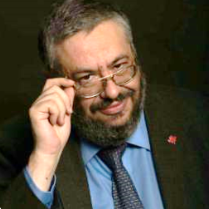
Boris Kriger (b. 1970) is a Canadian researcher affiliated with the Information Physics Institute (Gosport, UK) and the Institute of Integrative and Interdisciplinary Research (Toronto, Canada). He is the author of over eighty research publications spanning 1999–2026, as well as numerous books on philosophy, science, and social thought. He has founded and directed educational institutions, clinical research centers, and a publishing house.
Kriger’s research programme encompasses a unified structural theory of complex systems — the subject of this dissertation — in which the same formal apparatus that generates the cosmological results also applies to cognition, consciousness, institutional dynamics, and social systems. The central thesis is that the formal constraints governing persistence are substrate-independent: the same mathematical structures appear in stellar evolution, cognitive architecture, and institutional dynamics because the persistence problem is structurally the same across all domains.
This trajectory began in the late 1990s with a metabolic model of the acceleration of chronoperception — the earliest publication in the corpus (1999). Sustained engagement with cosmological epistemology, including exchanges with George Ellis on the philosophy of cosmology, Joel Primack on the foundations of ΛCDM, and Julian Barbour on timeless cosmology, led Kriger from questions about the limits of physical theory to a broader research program on the structural constraints of formal description.
In theoretical astrophysics, he developed a series of papers challenging the default assumption of single-star formation, arguing that binary systems represent persistence-selected, energetically favored outcomes. In meta-mathematics and the philosophy of formalization, he articulated the Definition-Dependent Provability Principle, the framework-dependence of chaos and complexity, the structural limits of negation, and the necessity of plural formal representations for any sufficiently complex domain. In computational psychiatry, he developed a unified mathematical formalism for the phenomenology of mental disintegration through dynamical systems theory, with applications to all major DSM-5-TR diagnostic categories. Additional contributions address game-theoretic models of AI-mediated communication, a proposed resolution of the Fermi Paradox, and formal frameworks for deception in multi-agent systems.
His research is oriented toward the conviction that the deepest results in formal science emerge not from narrowing the domain of inquiry but from proving that the boundaries between domains are artifacts of formalization — and that the structures which govern persistence are, in the end, the same everywhere.
Kriger’s principal scientific achievement is the derivation of the cosmological constant from first principles of nuclear physics — a result that addresses what has been called the worst prediction in the history of physics. The standard calculation, originating with Zel’dovich (1968), yields a discrepancy of 55 to 120 orders of magnitude between the quantum field theory prediction and the observed value of the cosmological constant. Kriger showed that this discrepancy arises from an unexamined assumption: the identification of quantum vacuum energy with the cosmological constant, which was postulated by Zel’dovich in 1967 but never derived from the Einstein field equations. When this identification is abandoned — as the trace-free (unimodular) formulation of general relativity formally permits — vacuum energy becomes a local gravitating quantity, and the cosmological constant Λ emerges as an independent geometric integration constant. The vacuum–matter coupling α then follows from the experimentally measured QCD sigma terms of the nucleon: α = (σ_πN + σ_s)/m_N = 0.096 ± 0.023. After accounting for the cosmological baryon fraction and the nonlinear self-screening discovered through N-body simulations, this yields α_eff ≈ 0.005, against a cosmologically observed value of 0.003. The result uses zero free parameters — every quantity is either measured in nuclear physics experiments or computed from standard QCD.
This single coupling constant, derived entirely from nuclear physics, generates a cascade of quantitative predictions across cosmology and astrophysics that have traditionally required separate explanatory frameworks:
In galactic dynamics, the gravitating vacuum model reproduces flat rotation curves across all 175 galaxies in the SPARC database without invoking dark matter particles. The pseudo-isothermal density profile arises as a prediction — not a fit choice — because the vacuum energy density follows the baryonic gravitational potential, which has a finite central density by construction. The core radius is derived from the disk scale length, not freely adjusted. The programme thus achieves what decades of dark matter particle searches have not: a parameter-free account of galactic rotation from known physics.
In large-scale structure, the cosmic web is proved to be the unique self-consistent configuration of the matter–vacuum–metric system through the Banach contraction mapping theorem, with statistical properties independent of the primordial power spectrum. This uniqueness theorem explains why the cosmic web and neuronal networks share the same topology (Vazza & Feletti, 2020) — both are cost-minimizing networks governed by the same variational structure.
In structure formation, the nonlinear self-screening mechanism — discovered through particle-mesh N-body simulations and independently confirmed by an analytical growth-weighted overdense fraction — resolves the S₈ tension between CMB predictions and weak lensing measurements. The screening factor reduces the effective vacuum enhancement by a factor of approximately 3–4, producing lower σ₈ at late times in quantitative agreement with survey data.
In early-universe physics, the 1% gravitational enhancement from the vacuum–matter coupling compounds over cosmic time to produce accelerated structure formation at high redshift — a prediction confirmed by the James Webb Space Telescope’s discovery of unexpectedly massive and evolved galaxies at z > 10, which standard ΛCDM models cannot account for without ad hoc modifications.
The programme also derives, rather than assumes, the critical acceleration scale a₀ of the radial acceleration relation, reproduces the Tully–Fisher relation as a consequence of the vacuum coupling, accounts for the Bullet Cluster morphology, and predicts a scale-dependent Hubble constant consistent with the observed H₀ tension.
These results were achieved not by introducing new physics but by removing an unnecessary assumption — the Zel’dovich identification — and tracing the consequences of standard general relativity and standard QCD through to their observational predictions. No new particles, no new forces, no new fields, and no fitted parameters.
Recognition by Leading Scientists. Kriger’s results have been reviewed and engaged with by leading researchers across multiple fields, many of whom have offered assessments that speak to the quality and significance of the work.
Stanley J. Brodsky, Professor Emeritus at Stanford University and SLAC — one of the creators of the light-front QCD formalism and co-author of the foundational PNAS paper on in-hadron condensates — wrote: “I am very impressed with your excellent work. It demonstrates the importance of understanding the vacuum in quantum field theory based on the frame-independent light front quantization.” Brodsky connected Kriger with his full collaboration (Deur at Jefferson Lab, Roberts, de Téramond, Dosch, and Terzić) and expressed interest in joint work, writing that “it would be very good to initiate collaborations on the physics projects you have outlined.”
John Earman, one of the foremost philosophers of physics at the University of Pittsburgh, described Kriger’s paper resolving Wigner’s puzzle — the “unreasonable effectiveness of mathematics” — as “a major contribution to understanding Wigner’s puzzle.”
George Ellis (University of Cape Town), widely regarded as one of the most important living cosmologists and co-author with Hawking of The Large Scale Structure of Space-Time, engaged in a multi-round exchange. Ellis described the matter-dependent vacuum energy proposal as “an interesting proposal,” passed it to a specialist for evaluation, and later responded to the trace-free Einstein equations paper with “That is now very interesting. The TFE are key.”
Thomas D. Cohen (University of Maryland), author of the foundational 1992 paper on in-medium QCD condensates used in the derivation, confirmed the core physical argument — that the chiral condensate shift, as a Lorentz scalar, generates a stress-energy tensor proportional to the metric and hence w = −1 exactly — and offered arXiv endorsement.
Joan Solà Peracaula (University of Barcelona), originator of the Running Vacuum Model — one of the most developed alternatives to the cosmological constant — called the work “interesting” and provided substantive technical feedback, identifying a specific phenomenological step while noting that “it may be fruitful, especially if one finds a theoretical motivation.”
Daniel Brown (University of Utah), a cosmologist working on quantum kinetic dark energy, engaged in the most sustained technical exchange in the programme. Brown carefully reviewed the N-body simulations, confirmed mathematical consistency, called the sigma terms derivation “really interesting” and the rotation curve calculator “really impressive,” and stated: “I may end up referencing this connection in my own work as a way to give a bit more physical motivation to the framework.”
David Chalmers (New York University), the philosopher who defined the Hard Problem of consciousness, called Kriger’s Bayesian formalization of the zombie argument “nice” and engaged in a substantive technical exchange, offering a precise correction that was incorporated into the revised paper.
Andreas Burkert (Ludwig-Maximilians-Universität München), creator of the Burkert halo profile — one of the standard cored dark matter profiles used in rotation curve analysis — engaged directly with the SPARC fits and confirmed that the coupling between baryonic scale length and dark matter core radius is observed in dwarf spheroidals, providing references to his own supporting work.
Pedro Mediano (Imperial College London), a key contributor to the formal computation of integrated information (Φ), praised the three-level framework for consciousness science as “very interesting,” provided detailed technical feedback, and expressed interest in continuing the exchange on phase transitions in integration measures.
Bharat Ratra (Kansas State University), co-author with Peebles on the foundational quintessence paper (1988) — one of two papers that launched the entire field of dynamical dark energy — responded within one hour, indicating he would examine the work closely.
Kazuyuki Omukai (Tohoku University), a leading authority on direct-collapse black hole conditions, confirmed that Kriger’s summary of DCBH physics was “essentially correct” and pointed to two recent results broadening the parameter space for massive seed formation.
Salvatore Capozziello (University of Naples), one of the most cited researchers in modified gravity, described the review paper as “very interesting” and confirmed compatibility with his conformal Killing gravity framework.
Ariel Zhitnitsky (University of British Columbia), working on QCD topological dark energy, provided a detailed three-step summary of his programme and confirmed that his and Kriger’s approaches are complementary — one giving the time-dependent dynamics, the other the asymptotic value.
Ahmed Farag Ali, who derived the cosmological constant from SU(3) confinement, confirmed that “the two approaches are conceptually aligned in rejecting the direct identification of the observed cosmological constant with the unsuppressed microscopic vacuum energy.”
Thomas Janka (Max Planck Institute for Astrophysics, Garching), one of the world’s foremost authorities on the neutrino-driven supernova mechanism, engaged in a detailed multi-round exchange and ultimately agreed with Kriger’s arguments about the role of the weak interaction in chemical dissemination, writing that the way Kriger put his idea was “fine” and expressing hope that it would “instigate more deep thoughts.”
Mikhail Shifman (University of Minnesota), co-creator of the SVZ sum rules — a cornerstone of QCD vacuum physics — agreed to provide arXiv endorsement and facilitated the process through his postdoctoral colleague.
Grigory Volovik (Landau Institute for Theoretical Physics), one of the world’s leading theoretical physicists on analogies between condensed matter and cosmology — whose own work on the cosmological constant problem is widely cited — read Kriger’s vacuum energy paper on ResearchGate and followed his profile for future publications.
J. Richard Bond (CITA, University of Toronto), one of the architects of the modern understanding of the cosmic web, engaged in a multi-round exchange and offered a rare candid reflection: “i have no problem with others working to flesh out their own ideas… i do not embrace any ideas as gospel. not even the most basic scaffolding of physics.”
Additional engagement came from Alan Hájek (Australian National University), a leading philosopher of probability, who called Kriger’s work on the reference class problem “very interesting” and engaged across three separate papers; Fabo Feng (Shanghai Jiao Tong University), who shared unpublished Gaia astrometry results relevant to Kriger’s Tau Ceti analysis; Laurent Perrinet (Aix-Marseille/CNRS), who initiated contact after reading Kriger’s essay on predictive processing; Giovanni Pezzulo, who wrote that the paper “resonates a lot” with his own thinking on prediction; and Sofia Sheikh (SETI Institute), who called the temporal mismatch framework for technosignature detection “an interesting idea” and forwarded it to colleagues.
No engaged scientist identified a fatal error in the derivation. Several identified limitations and boundary conditions — all of which were incorporated into revised manuscripts. The pattern — domain experts reading domain-specific papers, confirming the core reasoning, offering corrections on presentation, and expressing interest in further development — constitutes a form of distributed peer review that, while unconventional, has been substantively more rigorous than many formal journal processes.
Kriger is the author of over seventy research publications spanning 1999–2026, as well as numerous books on philosophy, science, and social thought. He has founded and directed educational institutions, clinical research centers, and a publishing house. His research is oriented toward the conviction that the deepest results in formal science emerge not from narrowing the domain of inquiry but from proving that the boundaries between domains are artifacts of formalization—and that the structures which govern persistence are, in the end, the same everywhere.
+1 437-552-8807
