
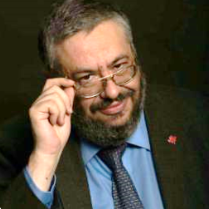
Boris Kriger (b. 1970) is a Canadian researcher affiliated with the Information Physics Institute (Gosport, UK) and the Institute of Integrative and Interdisciplinary Research (Toronto, Canada).
His interests span the foundations of physics, mathematical modeling of complex adaptive systems, computational psychiatry, cognitive science, and the philosophy of formalization.
He holds a background in medicine and clinical research, having trained and practiced in hospital settings before founding clinical research organizations in Israel and Canada that conducted pharmaceutical trials and trained thousands of professionals internationally.
Kriger’s research trajectory is deliberately and irreducibly interdisciplinary. The breadth of his work—spanning astrophysics, meta-mathematics, cognitive science, computational psychiatry, social theory, and the philosophy of formalization—is not incidental but methodologically essential. The central thesis of this dissertation is that the formal constraints governing persistence are substrate-independent: the same mathematical structures appear in stellar evolution, cognitive architecture, and institutional dynamics because the persistence problem is structurally the same across all domains. Demonstrating this claim requires working across domains. A researcher confined to a single discipline would observe the constraints operating within that discipline but could not prove that they are universal. The interdisciplinary scope of Kriger’s program is therefore not a departure from rigor but a precondition for the kind of rigor the theory demands—the rigor of substrate-independent proof rather than domain-specific modeling.
This trajectory began in the late 1990s with a metabolic model of the acceleration of chronoperception—the earliest publication in the corpus (1999). Sustained engagement with cosmological epistemology, including exchanges with George Ellis on the philosophy of cosmology, Joel Primack on the foundations of ΛCDM, and Julian Barbour on timeless cosmology, led Kriger from questions about the limits of physical theory to a broader research program on the structural constraints of formal description when applied to systems that are singular, self-referential, or irreducibly uncertain.
In theoretical astrophysics, Kriger developed a series of papers challenging the default assumption of single-star formation, arguing that binary systems represent persistence-selected, energetically favored outcomes. Related contributions address dormant neutron star populations, protostellar core formation paradoxes, and critical evaluations of holographic and alternative cosmological models. In meta-mathematics and the philosophy of formalization, he articulated the Definition-Dependent Provability Principle, the framework-dependence of chaos and complexity, the structural limits of negation, and the necessity of plural formal representations for any sufficiently complex domain.
A major strand of recent work applies formal methods to complex adaptive systems and cognition. This includes the Viability Mismatch Law, the Constraint–Autonomy Compatibility Law, the Structural Distortion Principle, and the Pre-Integrative Rejection Principle. Related results address the evolutionary inevitability of predictive processing, representational isolation as a formal necessity, and the eruptive manifestation of model–reality mismatch in bounded adaptive systems. In computational psychiatry, Kriger has developed a unified mathematical formalism for the phenomenology of mental disintegration through dynamical systems theory, with applications to all major DSM-5-TR diagnostic categories, extending the Scheffer et al. (2024) framework with stochastic differential equations, bifurcation analysis, and novel formalizations of anosognosia, gaslighting, collective phase transitions, and punitive psychiatry.
Additional contributions address game-theoretic models of AI-mediated communication and norm shift, the structural conditions under which advanced civilizations turn inward (a proposed resolution of the Fermi Paradox), thermodynamic analysis of algorithmic compression in large-scale AI systems, information-theoretic estimates of biospheric contribution to cosmic complexity, and formal frameworks for deception in multi-agent systems.
Kriger’s clinical background—years spent in neurological and internal medicine wards, face to face with the realities of human suffering, cognitive fragility, and systemic failure in healthcare—informs the program’s insistence that formal theory must ultimately answer to the complexity of the real. The combination of medical practice, entrepreneurial experience in building organizations from the ground up, and sustained theoretical work across the sciences has produced a researcher whose instinct is to seek the structural invariant beneath the domain-specific surface. This instinct is the methodological engine of the unified structural theory.
Kriger is the author of over seventy research publications spanning 1999–2026, as well as numerous books on philosophy, science, and social thought. He has founded and directed educational institutions, clinical research centers, and a publishing house. His research is oriented toward the conviction that the deepest results in formal science emerge not from narrowing the domain of inquiry but from proving that the boundaries between domains are artifacts of formalization—and that the structures which govern persistence are, in the end, the same everywhere.
+1 437-552-8807
 Institute of Integrative and Interdisciplinary Research